
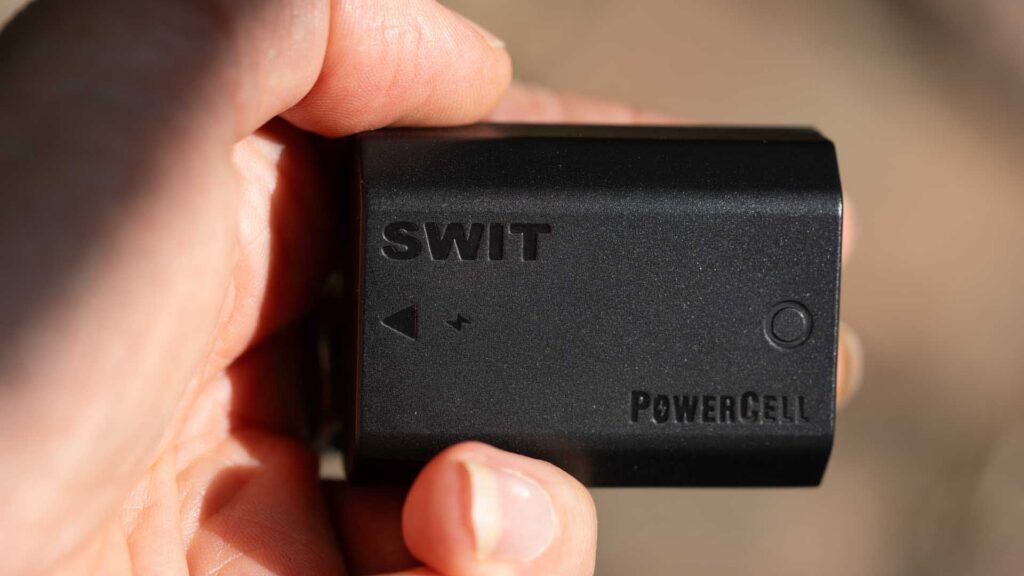
The Swit PowerCell Camera Batteries are a useful alternative to the manufacturer’s original batteries, with the added convenience of direct Universal Serial Bus Type-C (USB-C) charging and a four-level light emitting diode (LED) power indicator. I tested the Sony NP-FZ100 version in the Sony A7R IV, A7 III and A7 V and found its performance indistinguishable from my original Sony batteries.
Being able to charge it from a power bank and check its charge before putting it in the camera are particularly useful when travelling or trying to keep the amount of kit in your camera bag to a minimum.
The Swit PowerCell Camera Battery is a rechargeable lithium ion camera battery designed as an alternative to the manufacturer’s original battery while adding direct USB-C charging and an external power level indicator.
Swit offers PowerCell batteries for a range of Canon, Fujifilm, Nikon and Sony cameras. The versions include alternatives to the Canon LP-E6P, Fujifilm NP-W235, Nikon EN-EL15c and Sony NP-FZ100 batteries.
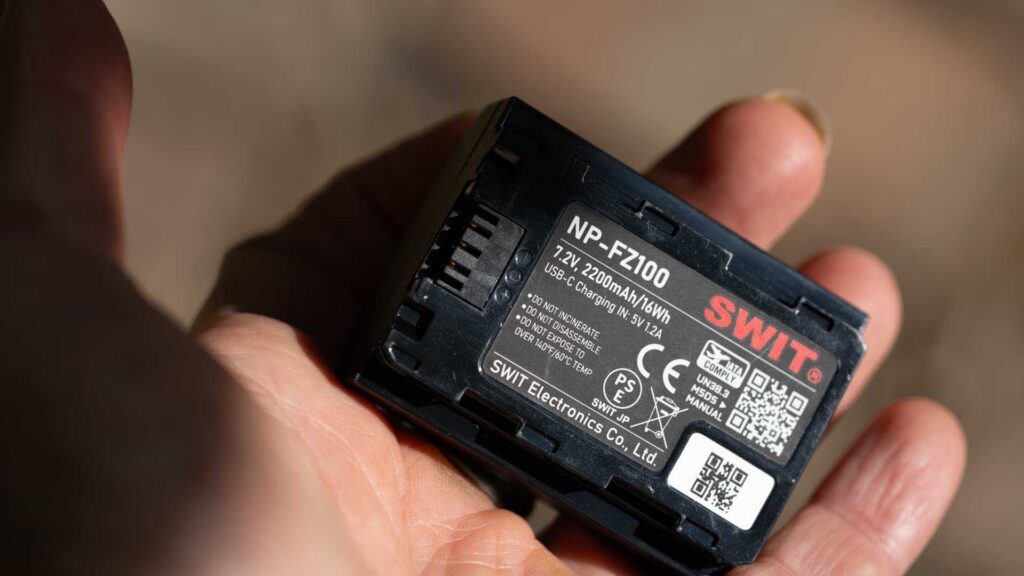
I’ve been testing the Sony NP-FZ100 version, which has a nominal voltage of 7.2V and a capacity of 2200mAh or 16 watt hours. It uses Panasonic NCR1850 cells and is designed to be the same size and shape as the original Sony NP-FZ100 so that it can be used in compatible cameras and chargers in the usual way.
That means you don’t have to change how you work with your camera. You can charge the PowerCell in the camera, use a compatible dedicated charger or make use of the USB-C port built directly into the battery.
Swit’s manual also states that the battery is fully decoded, so there should be no pop up warnings when it is used in a compatible camera. It supports the camera’s own battery level display and is designed to provide the camera with information about the remaining battery power.
Read our Viltrox AF 35mm F1.2 LAB N FE Review
At the time of writing, the Swit PowerCell Sony NP-FZ100 type battery is available directly from Swit’s website for $58.30. Shipping to the UK is quoted at $4.99, bringing the total to around £46.40 at the exchange rate I used for this review.
That’s less than the usual price of an original Sony NP-FZ100, which is often around £65. However, Sony batteries are widely stocked and discounts aren’t unusual, so you may find an original battery for closer to £50 if you shop around.
Consequently, the Swit battery isn’t necessarily about making a huge saving. Its main attraction is the extra flexibility offered by the USB-C charging port and external battery indicator.
Swit also makes PowerCell batteries to replace several popular Canon, Fujifilm and Nikon batteries, so it’s worth checking that you’re buying the correct version for your camera.
The Swit PowerCell NP-FZ100 is rated at 7.2V with a capacity of 2200mAh and 16 watt hours, putting it in the same general class as the original battery it is designed to replace.
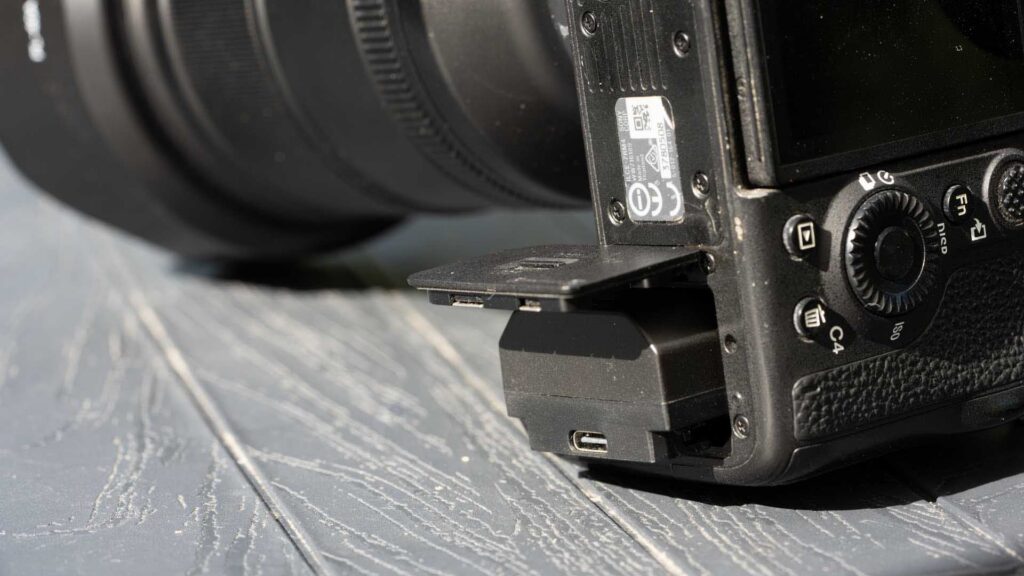
Its most interesting feature is the USB-C charging port built into the side. This accepts a 5V, 1.2A input. Consequently, the battery can be connected directly to a suitable USB mains adapter or a power bank without the need for a separate battery charger.
That’s useful at home but it makes even more sense when you’re travelling. I’m very conscious of how quickly all the little accessories add up in a camera bag. A battery charger doesn’t weigh a huge amount by itself but once you’ve added chargers for a camera, phone, watch and perhaps a laptop, the cables and adapters can become a nuisance. Being able to use the same USB charging setup for the battery as other devices helps simplify things.
For direct charging, I used a UGREEN USB C Plug 100W Fast Charger GaN (gallium nitride) 4-Port, which is the charger I normally use both at home and when travelling. Although it’s capable of delivering up to 100W, the PowerCell only takes the power its USB-C input is designed to accept. The battery became a little warm while it was charging, but I didn’t encounter any major issues.
You don’t have to use the USB-C connection because the battery can also be charged in the normal way. Swit’s manual lists the Sony BC-QZ1 and BC-ZD1 as compatible chargers, along with Swit’s own UC-2065. I used the Sony BC-QZ1 and Newell FDL-USB-C Dual-Channel Charger For NP-FZ100 chargers without a problem.
The charging time depends on how you charge the battery. The specification list gives an approximate charging time of 230 minutes (3.8 hours) through the USB-C port and around 107 minutes using the Sony BC-QZ1 charger.
There is a slight difference between those figures and the reference figures in the supplied manual. The manual quotes around 3.5 hours for USB-C charging at 5V and 1A and around 1.5 hours with an 8.4V, 2A charger. In practice, the main point is unchanged: direct USB-C charging is convenient but a dedicated charger is the faster option.
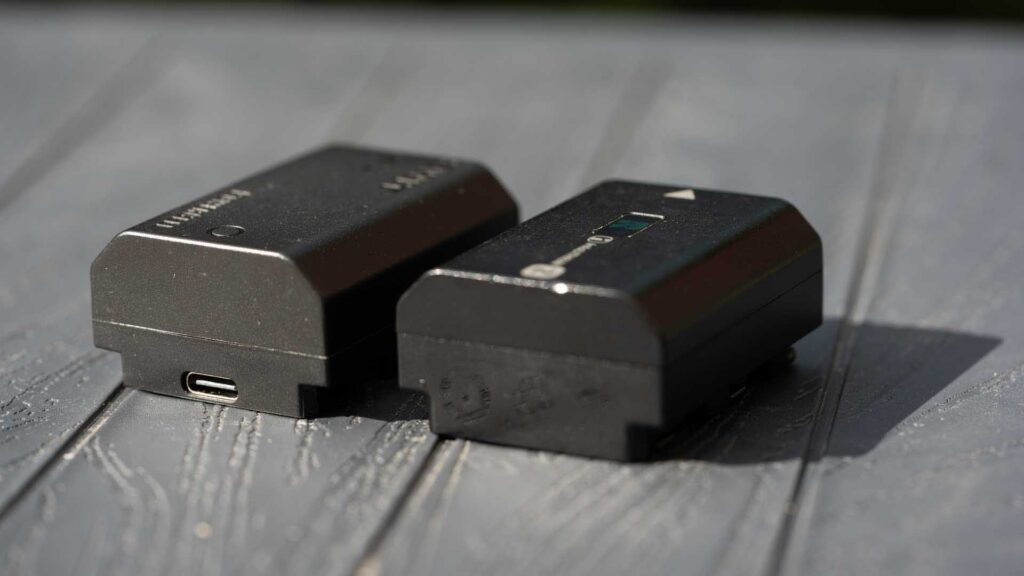
Swit has built a four-level LED power indicator into the top of the battery. The lights flash while the battery is charging and provide a visual indication of its current state.
There’s a small touch button beside the LEDs that lets you check the charge level without putting the battery into a camera. The manual indicates that four illuminated lights mean the remaining charge is at least 90%. Three lights indicate around 75% to 90%, two indicate 50% to 75% and one indicates 25% to 50%. If the battery is below 25%, none of the four main level lights is shown as illuminated.
That may seem like a small feature but it’s one I like. If you have two or three batteries in your bag, you can quickly check which one has the most charge without putting each one into the camera.
The PowerCell also communicates with a compatible camera, so once it’s installed, you can continue to use the camera’s normal battery level display rather than relying on the LEDs.
According to Swit, the Sony version is compatible with a long list of cameras including the Sony FX2, FX3, FX3A and FX30, the A7C and A7C II, the A7 III, A7 IV and A7 V, the A7S III, the A7R III, A7R IV and A7R V, the A1 and A1 II, the A9, A9 II and A9 III, the A6600 and A6700 and the ZV-E1.
The new Sony A7R VI uses a new NP-SA100 with the Sony A7R VI, which means the Swit PowerCell NP-FZ100-type battery is not compatible.
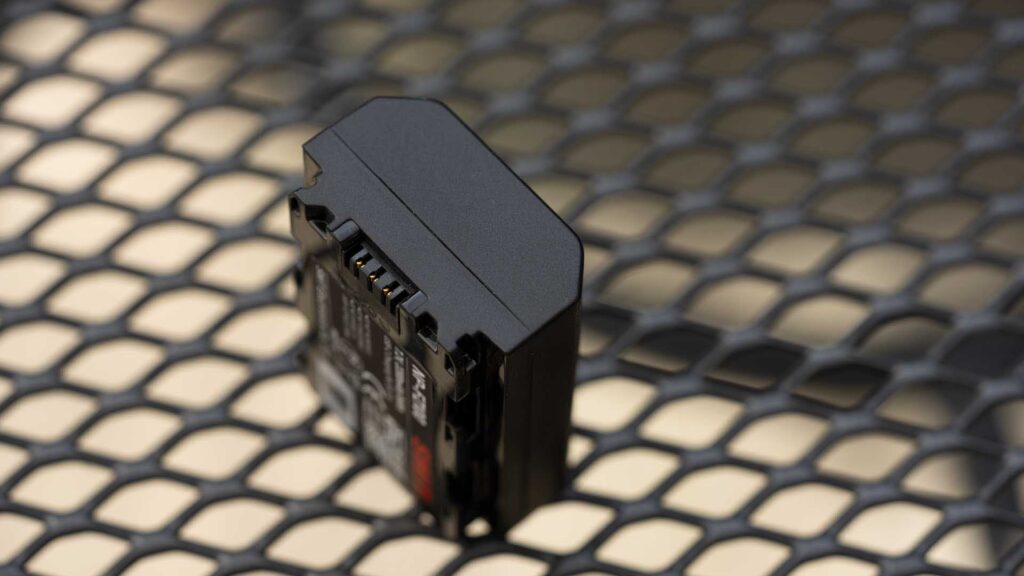
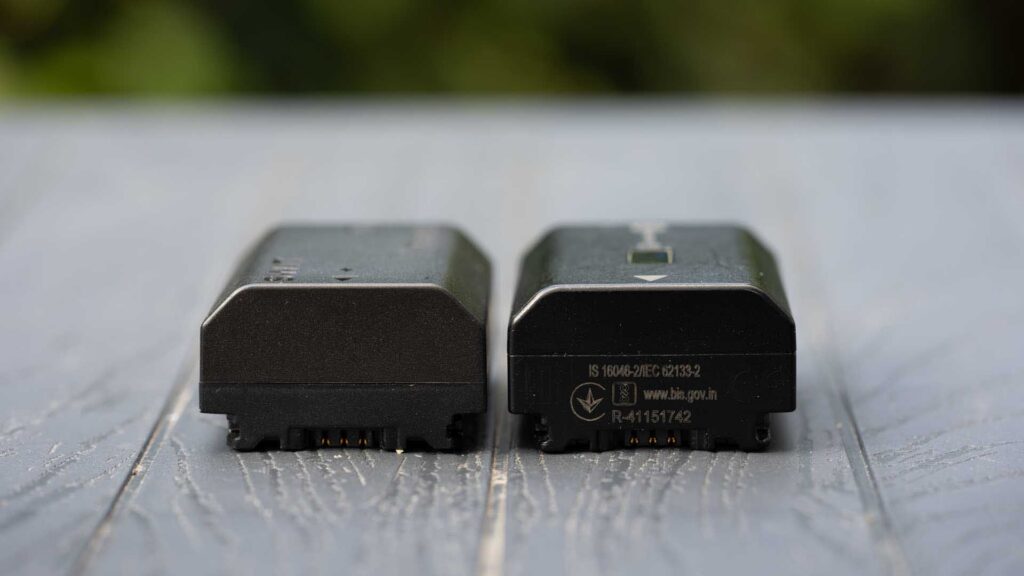
At 51.7 x 38.7 x 22.7mm, the Swit PowerCell NP-FZ100 is designed to match the dimensions of the Sony battery it replaces. Depending on whether you look at the online specification list or the downloadable manual, the weight is given as 80g or 78.5g, which is close enough that the difference is of no consequence in normal use.
More importantly, the dimensions are right. I used the battery in the Sony A7R IV, Sony A7 III and Sony A7 V and it slid smoothly into the battery compartment of each camera. There was no need to push or wiggle it into position and it released normally when the battery compartment catch was operated.
That’s something I always pay attention to with third-party batteries. A fractionally oversized casing can turn a cheaper battery into a false economy if it becomes awkward to remove from a camera. I didn’t have that problem with the PowerCell.
Although its basic dimensions and shape are familiar, the PowerCell is easy to distinguish from an original Sony battery. The USB-C charging socket is visible on the side while the upper surface has the LED power indicators, charging indicator and touch-sensitive power test button.
The power test button is particularly useful when you’re getting ready for a shoot. Rather than picking up a battery and wondering whether you remembered to charge it, you can touch the button and get an immediate indication.
That’s handy if your camera bag sometimes contains a mixture of freshly charged and partly used batteries after a few days of photography.
The battery feels solid enough in the hand and I haven’t noticed anything about its construction that would make me treat it differently from the original Sony batteries that I routinely carry.
Read Our Sony FE 100mm F2.8 Macro GM OSS Review
Rather than set up a series of artificial battery rundown tests, I used the Swit PowerCell NP-FZ100 as I would any other battery.
That means putting it in the Sony A7R IV, heading out with the camera and taking photographs normally. Some days involve lots of shooting and reviewing images while others see the camera carried for hours but used only occasionally.
Then I get home, I glance at the battery indicator and realise there’s still around half of the charge left. I recharge it before heading out again the following day. That’s a much more realistic reflection of how I use a camera battery than continuously firing the shutter until the camera switches off.
In that kind of everyday use, I found the Swit PowerCell Sony NP-FZ100 type battery indistinguishable from the original Sony batteries I’ve been using.
The camera recognised it correctly, the battery level information was available as expected and I didn’t see any warning messages. I could simply put the PowerCell in the camera and forget about it.
That’s exactly what I want from a third-party battery.
The additional features become useful when the battery isn’t actually in the camera. The ability to check the charge level before fitting it is particularly handy if you’re reaching into a bag for a spare battery during a shoot.
It’s also useful when packing the night before. I often want to know whether a battery has enough charge for the following morning or whether it needs topping up. Tapping the button is much quicker than putting it in a camera just to check.
Direct USB-C charging also works well with the way many of us now travel. At home and away I used my UGREEN USB C Plug 100W Fast Charger GaN 4-Port, the same charger that I use for several of my other devices. The PowerCell became a little warm while charging but not excessively so and I experienced no major issues.
A reasonably powerful power bank is also a useful addition to a photographer’s bag because it can keep a phone and other devices running during a long day. With the PowerCell, it can recharge your camera battery as well.
That doesn’t mean the battery can magically charge more quickly. A dedicated charger is the better choice if speed is important, but the USB-C port gives you another option.
For example, if you’re travelling by train after a morning’s photography, you can connect the battery to a power bank in your bag and let it recharge on the journey. Similarly, if you’re staying somewhere with limited sockets, you don’t need to find room for a separate camera charger.
I think that flexibility is likely to appeal to many women who travel for photography or who simply prefer to carry less equipment on a day out. When you’re already carrying a camera, a couple of lenses and all the other small essentials that find their way into a camera bag, anything that reduces the number of chargers and cables you need to pack is welcome.
One other consideration with any third-party battery is whether its claimed compatibility translates into normal handling. In my testing, the answer was yes. I swapped the PowerCell between the Sony A7R IV, A7 III and A7 V without any fuss and its physical fit was as good as I would expect.
The Swit PowerCell Camera Battery does what I want a replacement camera battery to do. It fits properly, communicates with the camera and in everyday photography I couldn’t distinguish its performance from the original Sony NP-FZ100 batteries I normally use.
However, it also adds two genuinely useful features.
The first is direct USB-C charging. It’s slower than using a dedicated charger but the convenience is hard to ignore. You can connect the battery to the same type of power supply or power bank that you already carry for other devices, which may mean one less charger in your luggage.
The second is the external four-level battery indicator. It makes it easy to check a battery before putting it into the camera and that becomes increasingly useful as the number of batteries in your bag grows.
At around £46.40 including the UK shipping cost, the PowerCell isn’t dramatically cheaper than an original Sony NP-FZ100 if you hunt around for a good price. Its appeal isn’t purely about saving money.
Instead, it’s the combination of a reasonable price with more flexible charging and a useful external charge indicator that makes the Swit PowerCell interesting.
After using the Sony version in three cameras, I’d be happy to carry it alongside my original batteries. For women photographers who travel, attend workshops or spend long days away from a convenient mains supply, the ability to plug a camera battery directly into a USB-C cable or power bank makes a lot of sense.
It’s a simple idea but it removes a small amount of faff from keeping a camera powered and that’s something I appreciate every time I pack my bag.