
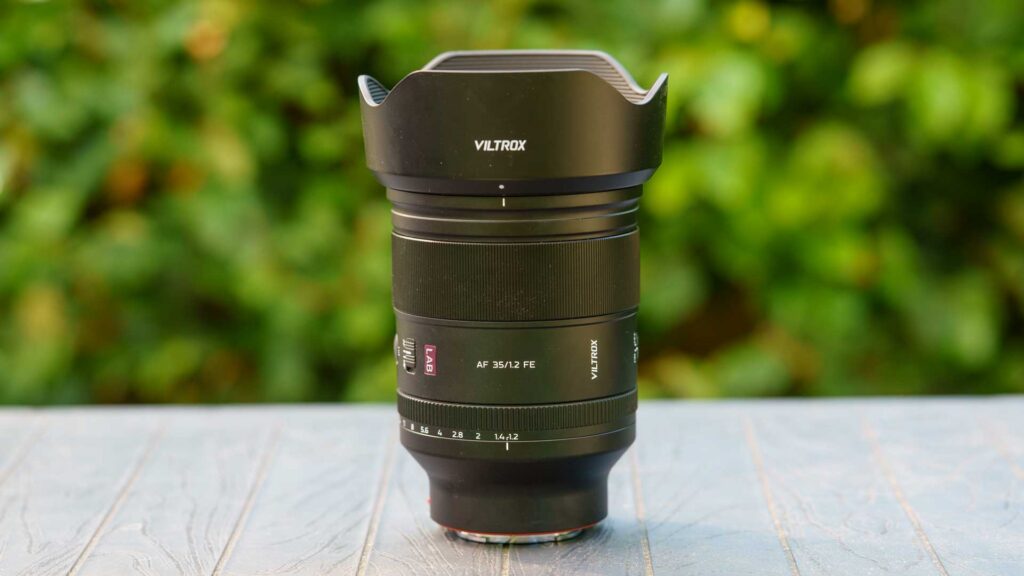
The Viltrox AF 35mm F1.2 LAB N FE is a large and heavy 35mm prime lens, but it rewards the effort of carrying it with very sharp images, smooth background blur and reliable focusing. Its f/1.2 maximum aperture is useful in low light, but its main attraction for me is the way it can isolate a subject while retaining a sense of their surroundings.
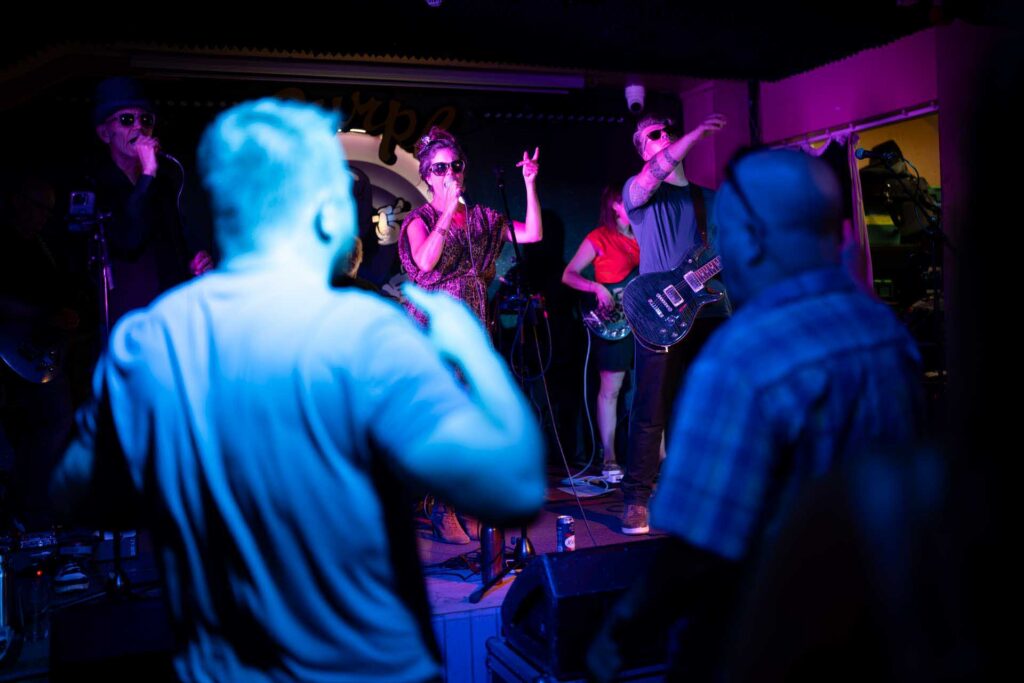
I particularly enjoyed using the lens at a local music gig, where I photographed the performers through members of the audience to capture the atmosphere of the event. The combination of the Viltrox lens and Sony’s eye detection allowed me to concentrate on the composition while trusting that the performer’s eye was sharp.
The dedicated aperture ring of this newer non-display version makes sense on a Sony camera, while its clicked or clickless operation suits both photography and video. There are a few minor handling frustrations, including the lack of an aperture ring lock and lack of support for the second function button on the Sony camera I used. However, the Viltrox AF 35mm F1.2 LAB N FE offers a great deal of creative potential for its £869 price.
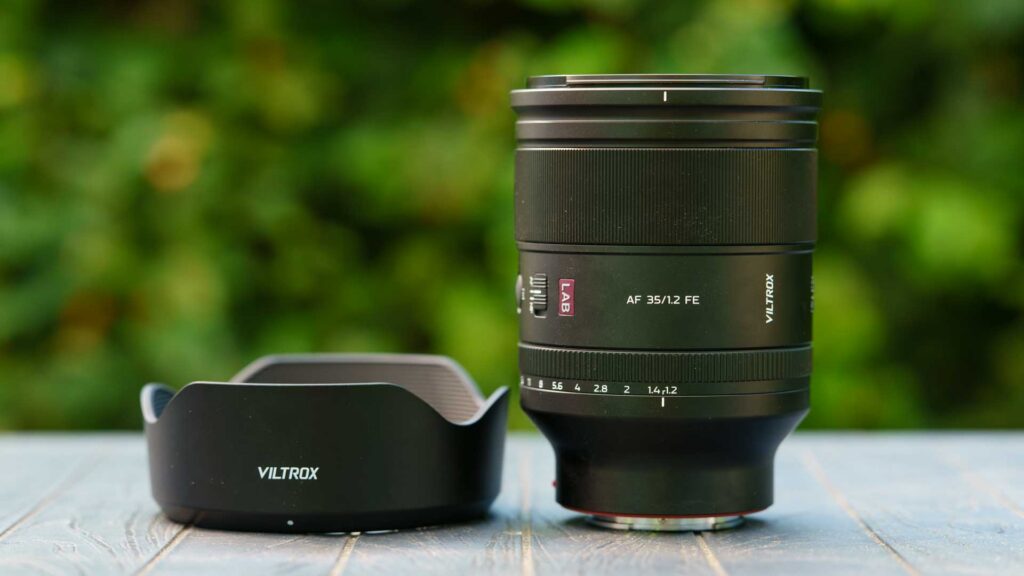
The Viltrox AF 35mm F1.2 LAB N FE is a full-frame wide-angle prime lens with an unusually large f/1.2 maximum aperture. The version reviewed here is designed for Sony E-mount mirrorless cameras, but Viltrox also offers the lens for Nikon Z-mount cameras.
A 35mm lens is a versatile choice for environmental portraits, street photography, documentary work, events, interiors and landscapes. It gives a wider view than a standard 50mm lens without introducing the more dramatic perspective associated with much shorter focal lengths. This makes it useful when you want to show a person within their surroundings rather than isolate them completely.
I have said before that I enjoy using wide-angle lenses with large maximum apertures. I like moving close to my subject and shooting at a wide aperture to create a dramatic transition between sharp and blurred areas. Consequently, a 35mm f/1.2 lens has obvious appeal to me.
Of course, when a lens opens all the way to f/1.2, it is tempting to use that aperture for everything. The reality is that the depth of field can sometimes be too shallow, particularly when you are working close to your subject. However, when the subject, focus and background come together, the effect can look wonderful. I live for those moments.
Viltrox offers two versions of the AF 35mm F1.2 LAB. The original Viltrox AF 35mm F1.2 LAB has a small OLED screen that displays the current focus distance and aperture. In manual focus mode, it also shows a distance scale and an approximate depth of field indication.
The original lens also has an unmarked customisable control ring instead of a conventional aperture ring. Depending on the camera, this can be assigned to adjust the aperture or another setting.
The Viltrox AF 35mm F1.2 LAB N FE reviewed here drops the display and replaces the customisable ring with a dedicated aperture ring. Optically, the two versions are the same, so the choice comes down to the type of control system you prefer.
The customisable ring has more potential on a Nikon camera because Nikon allows the control rings on compatible lenses to be assigned to different functions. Sony cameras do not offer lens ring customisation, so the marked aperture ring on the N FE version is a more logical choice for Sony photographers.
When the lens is mounted on a camera with an APS-C format sensor, its field of view is similar to that of a 52.5mm lens on a full-frame camera. It therefore becomes closer to a standard lens than a wide-angle optic. However, it’s a large lens for an APS-C format camera.
Read Our Viltrox AF 35mm F1.8 EVO II FE Review
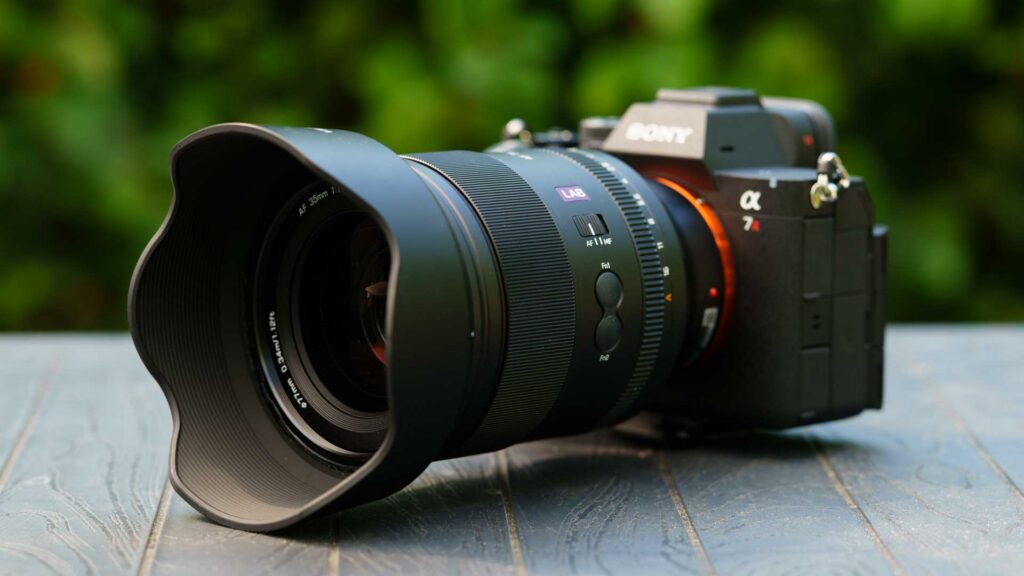
The Viltrox AF 35mm F1.2 LAB N FE has a retail price of £869 in the UK, €999 in Europe and $999 in the United States. It is available alongside the original display version rather than replacing it.
Both versions are listed at the same UK price, allowing photographers to choose between the display and customisable ring of the original lens or the more traditional marked aperture ring of the N FE model.
At £869, the Viltrox sits in an interesting position. The Sigma 35mm F1.4 DG II Art is listed at £849, making it a close competitor for photographers who do not need an f/1.2 aperture. The Sigma 35mm F1.2 DG II is listed at £1,299, while the Sony FE 35mm f/1.4 GM is £1,429.
Nikon photographers considering a native f/1.2 alternative face a much higher price of £2,899 for the Nikon Z 35mm f/1.2 S. Meanwhile, the Samyang AF 35mm f/1.4 FE II is listed at £636 and provides a smaller aperture at a lower price.
Viltrox also offers the Viltrox AF 35mm F1.8 EVO II FE, which is much more affordable at just £385. It doesn’t provide the same low light capability or potential for extremely shallow depth of field as the f/1.2 lens, but as our Viltrox AF 35mm F1.8 EVO II FE review demonstrates, it delivers excellent image quality. Its compact design and 355g weight also make it an attractive option for photographers who want a smaller and lighter everyday lens.
As this shows, there are smaller and less expensive 35mm lenses available, but the Viltrox AF 35mm F1.2 LAB N FE is aimed at photographers who specifically want the additional light gathering ability and shallow depth of field of an f/1.2 lens.
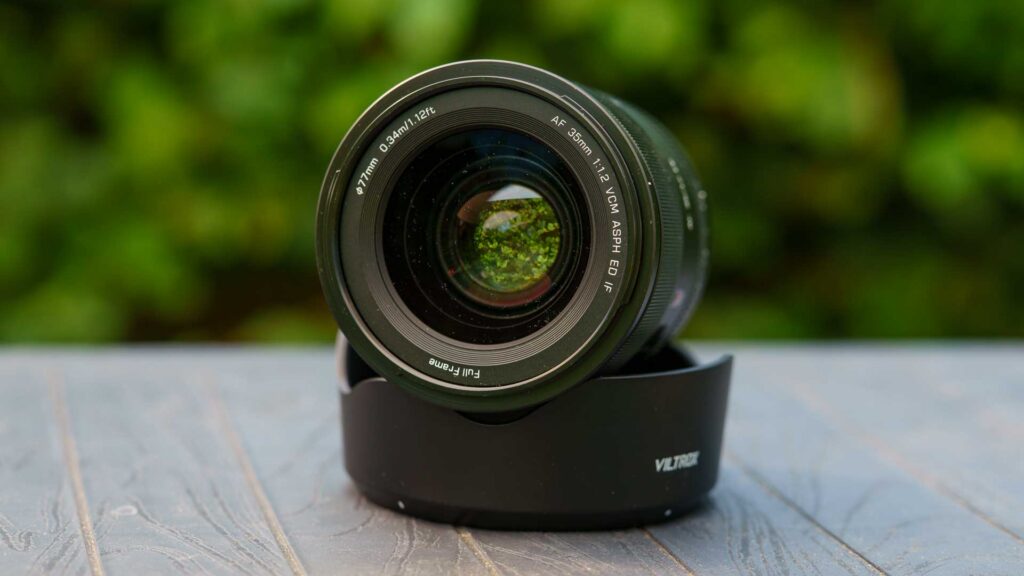
The Viltrox AF 35mm F1.2 LAB N FE comes with front and rear caps, a lens hood, a storage bag, a user manual and a warranty card. It accepts 77mm filters, which is a useful size because it is shared by many professional zoom lenses.
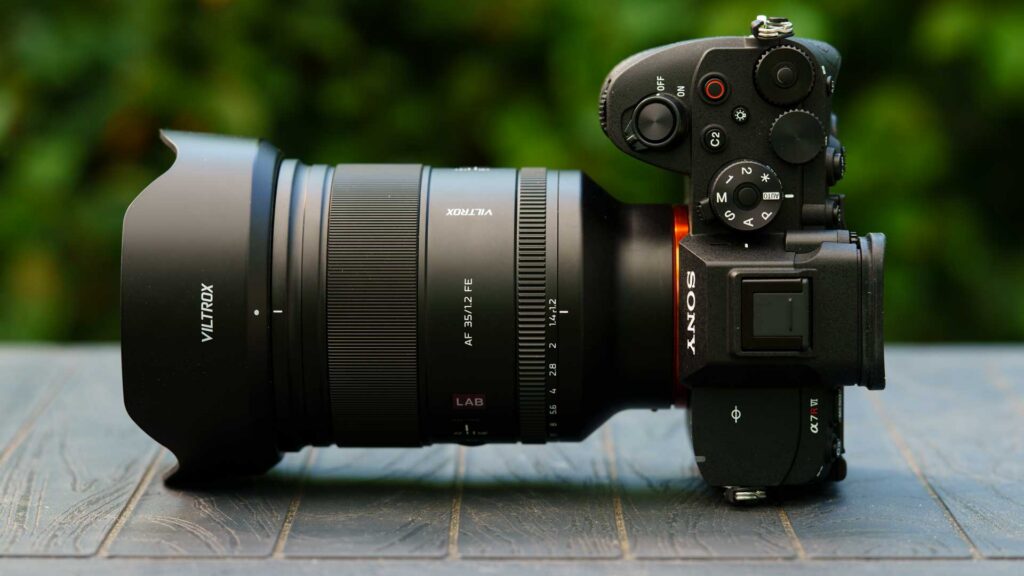
The Viltrox AF 35mm F1.2 LAB N FE is constructed from 15 elements arranged in 10 groups. Among these are three high refractive index elements, five ED (Extra-low Dispersion) elements and two UA (Ultra-precision Aspherical) elements.
These specialist elements are designed to control optical problems such as chromatic aberration while maintaining sharpness across the image frame. That is particularly important with an f/1.2 lens because producing consistent results at such a large aperture is more challenging than it is with a slower optic.
The maximum aperture of f/1.2 allows plenty of light to reach the camera’s sensor. In practical terms, this enables faster shutter speeds or lower sensitivity settings in dim conditions. It also gives you the option to create very shallow depth of field, particularly when the lens is focused close to its minimum distance.
The aperture closes down as far as f/16. An 11-blade diaphragm forms the opening and is designed to produce rounded out-of-focus highlights. The high blade count also helps the aperture remain relatively circular as it is closed down.
At f/1.2, the lens can produce extremely shallow depth of field, especially when it is focused near its minimum distance of 0.34m. The maximum reproduction ratio is 0.17x, so this is not a macro lens, but it allows you to get close enough for detail shots, food photography and tightly framed environmental portraits.
The focusing group is driven by four Viltrox HyperVCM (Hyper Voice Coil Motor) units. These motors are designed to move the focusing elements quickly, quietly and precisely. The focusing system also works with the camera’s face, eye and subject detection technology.
The lens uses a dual floating internal focusing system. As a result, the barrel does not extend and the front element does not rotate as the focus distance changes. This is useful when using graduated or polarising filters and it helps maintain the lens’ balance.
A switch on the barrel allows you to move quickly between automatic focus and manual focus. There are also two function buttons and a switch that changes the aperture ring from clicked to clickless operation.
The aperture ring is marked at f/1.2 and f/1.4, followed by full stop markings from f/2 to f/16. However, it clicks at one-third EV (Exposure Value) intervals, giving finer control than the printed scale might initially suggest.
Beyond f/16 is an A position, which transfers aperture control to the camera. Videographers can move the aperture click switch to its smooth setting, allowing quieter and more gradual exposure adjustments while recording.
Viltrox states that the lens has a sealed structure to resist dust and moisture. The front element has a water and smudge-resistant coating, while the barrel is made from aerospace-grade metal and the mount is plated brass.
The Viltrox AF 35mm F1.2 LAB N FE measures 89.2mm in diameter and 121.8mm in length. It weighs 910g, which makes it a substantial lens for its focal length.
Read Our Sony FE 100mm F2.8 Macro GM OSS Review
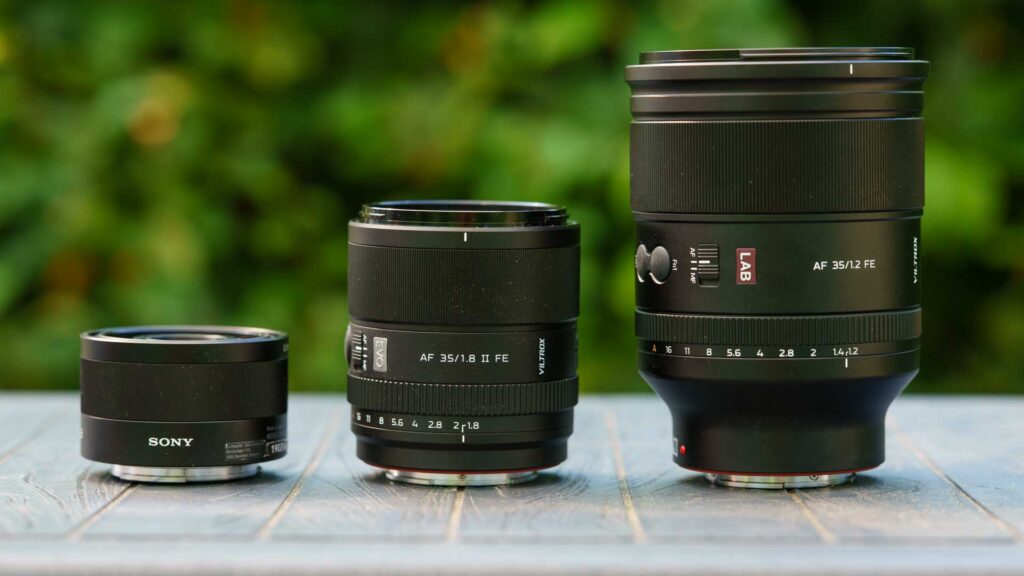
The Viltrox AF 35mm F1.2 LAB N FE is noticeably larger and heavier than most 35mm primes. That is not entirely unexpected because a full-frame lens with an f/1.2 maximum aperture needs large optical elements and the Viltrox has a complex 15 element construction.
Nevertheless, 910g is a significant addition to a camera bag and it changes the way a relatively compact mirrorless camera feels. This is not a lens that disappears on the camera or in your bag.
As a female photographer, I pay close attention to how a lens feels during a long shoot rather than judging it solely by the specifications. Camera equipment is often discussed as though weight is a minor issue, but it can influence how long we are comfortable shooting, the type of bag we carry and whether we are likely to take a lens with us in the first place.
During my testing, the Viltrox AF 35mm F1.2 LAB N FE balanced reasonably well on the Sony A7R VI, but I was always aware of its weight. I would always use a strap for an event or an extended walk and I would think carefully before packing it alongside several other large lenses. That said, the lens is right up my street, so I might leave others behind in favour of it.
Also, the Viltrox AF 35mm F1.2 LAB N FE feels very well made. Its metal barrel has a reassuring solidity and the lens mount feels robust. Plus, the weather-resistant construction gives me more confidence about using it outside when conditions are less than ideal.
The broad manual focus ring is positioned towards the front of the barrel. Its ridged surface makes it easy to identify by touch while looking through the viewfinder.
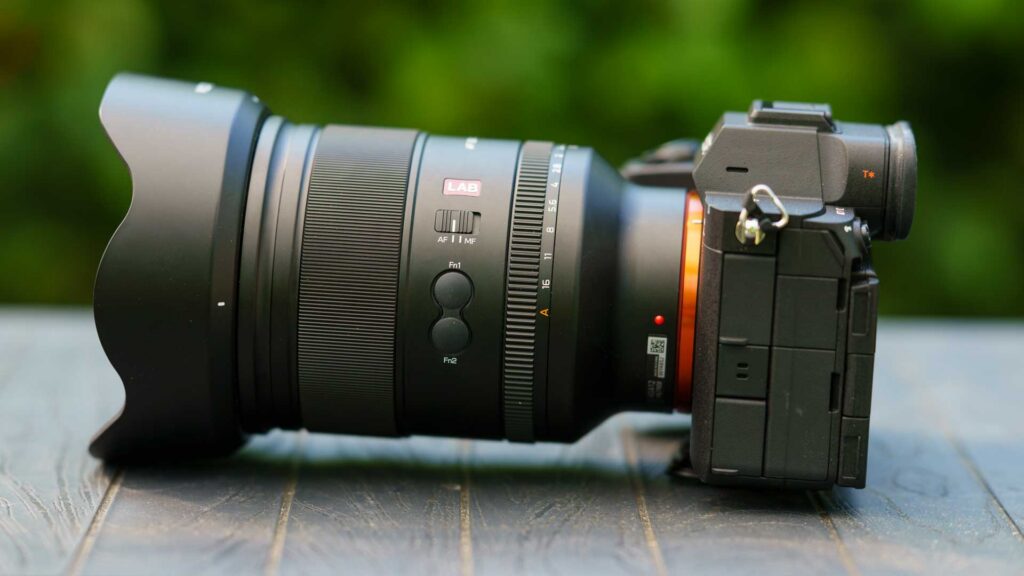
I find the focus ring’s movement to be just on the right side of free-moving. It turns easily with one finger, but it’s not so loose that it shifts regularly by accident. The focusing is electronic rather than mechanically linked, but the response feels natural enough for careful manual adjustments.
The aperture ring sits closer to the camera body. Its clicks provide clear feedback as it moves through the one-third-stop settings. They also make it easy to tell when the ring has passed the marked apertures and moved into the A position.
There is no aperture ring lock. To be fair, I didn’t find the ring excessively easy to move, but a lock would provide extra reassurance when working quickly or taking the camera in and out of a bag.
A switch on the right side of the barrel (when it’s on the camera and you’re holding it to shoot) allows the aperture clicks to be disengaged. This is mainly intended for video, where a clicking sound can be distracting. However, some stills photographers may also prefer the smoother movement.
The automatic focus and manual focus (AF/MF) switch is positioned on the left, along with two customisable function buttons. These buttons sit one above the other on the left side of the lens as you hold the camera.
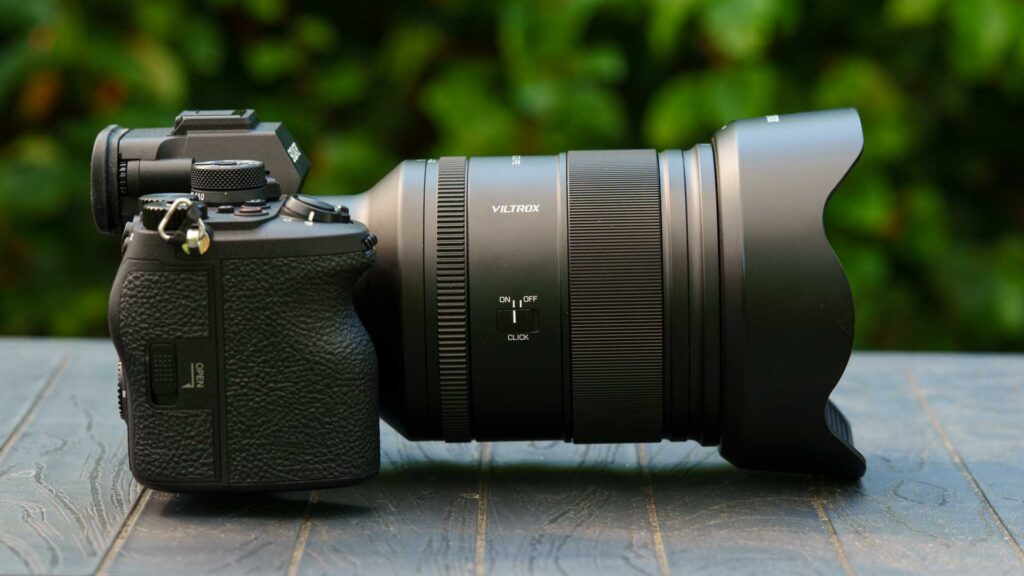
Unfortunately, the Sony A7R VI only recognises the first button, labelled Fn1, as a customisable control. I set it to toggle subject recognition on and off. This proves useful in busy locations where the camera might otherwise detect a stranger’s face or eye and move the focus away from my intended subject.
By default, the second button changes the focus between the nearest and furthest distances when the lens is in manual focus mode. That could be useful in some situations, but I tend to keep Sony’s full-time DMF (Direct Manual Focus) feature activated. This allows me to make manual adjustments with the focus ring while the camera’s autofocus system remains active.
Some photographers may prefer the two function buttons to be placed 90 degrees apart and assigned to the same operation. This arrangement would put one button within easy reach whether the camera is held horizontally or vertically.
The current vertical arrangement works well enough in landscape orientation, but neither button falls naturally under my hand when I rotate the camera for a portrait orientation image.
I tested the Viltrox AF 35mm F1.2 LAB N FE on the 66 megapixel Sony A7R VI. This is a demanding camera for any lens because its high-resolution sensor makes optical weaknesses easier to see.
The pairing works very well. The Viltrox AF 35mm F1.2 LAB N FE is capable of resolving a high level of detail and makes good use of the Sony camera’s resolution.
I particularly enjoyed using the lens at a local music gig. Rather than standing at the edge of the venue and photographing the performers in isolation with a long lens, I moved into the audience and photographed the band through the crowd.
This approach helped capture the feeling of the event while keeping the performers as the main subjects. Heads, shoulders and raised hands became foreground elements, giving the images more depth and a stronger sense of being among the audience.
Shooting at f/1.2 allowed me to blur those foreground elements while still showing enough shape and colour to establish the setting. It also meant that I didn’t have to push the ISO sensitivity especially high in the gloomy conditions.
The Viltrox lens’ autofocusing is fast, accurate and decisive on the Sony A7R VI. It also works very effectively with Sony’s eye detection system.
At the gig, once an eye was detected, I could concentrate on the timing and composition rather than worrying continually about whether the subject was sharp. With the camera looking after the performer’s eye, I was able to wait for the foreground shapes, expressions and gestures to come together before pressing the shutter release fully.
That support is particularly valuable at f/1.2 because the depth of field can be very shallow. A slight focusing error can mean that eyelashes are sharp while the iris is not, or that the focus falls on the nearest person in a crowd rather than the performer beyond them.
The focusing mechanism is also quiet and its movements are smooth, which makes the lens suitable for video as well as stills. However, there is noticeable focus breathing. The angle of view appears to tighten as the focus moves closer to the camera, so videographers planning visible focus pulls should take this into account.
The Viltrox AF 35mm F1.2 LAB N FE produces very good central sharpness at f/1.2. There is a small improvement at f/1.4, but the difference is modest enough that there is no reason to avoid using the maximum aperture when it suits the image.
Sharpness remains at a high level through the rest of the aperture range. There is a very slight reduction at the smallest aperture as diffraction takes effect, but this is to be expected and it is not a major concern.
The corner performance is also very impressive. The corners don’t quite match the centre at the widest apertures, but they retain a good level of detail. This means you don’t have to keep the main subject in the middle of the frame to obtain a sharp result.
That is important for environmental portraits and documentary photography, where placing a person away from the centre can produce a more interesting composition. It is also useful for landscapes and interiors, where detail is often required across much of the image.
The corners are darker than the centre at f/1.2, but the shading changes gradually rather than appearing as a hard or obvious transition. In some portraits or low light images, this may help direct attention towards the subject, but equally, it can go unnoticed.
The vignetting reduces as the aperture is closed and it is effectively gone by f/2.8.
Distortion is also controlled very well. When I photographed a brick wall, I detected a very slight hint of pincushion distortion, where straight lines bend inwards towards the centre of the image. However, the effect is very minor.
I wouldn’t think twice about using the Viltrox AF 35mm F1.2 LAB N FE for architecture or interior photography. Any small amount of residual distortion should be straightforward to correct when necessary.
I also examined areas with high contrast edges and saw one or two examples of what may be very mild chromatic aberration. However, it’s so slight that I question whether it’s worth mentioning.
In practical use, coloured fringing is controlled very well and should not present a significant problem. Flare is also kept under control, although fitting the supplied hood is sensible when a bright light source is near the edge of the frame.
The quality of the out of focus areas is central to the appeal of an f/1.2 lens and the Viltrox AF 35mm F1.2 LAB N FE handles them nicely.
At f/1.2, the transition from sharp to blurred areas is rapid. Backgrounds become deeply blurred when the subject is close, making it easy to separate a person, animal or detail from their surroundings.
The blur is smooth and does not have the busy character that can make some backgrounds distracting. Out of focus highlights are also rendered cleanly, without strong outlines or obvious internal patterns.
Highlights towards the edge of the frame can become slightly cat’s eye shaped at the widest aperture. This is a common characteristic of large aperture lenses and I don’t find it especially distracting.
Depending upon the subject distance, the lens’ 35mm focal length means that the background doesn’t disappear as completely as it might with a fast 85mm portrait lens. Instead, it remains recognisable while being softened enough to keep attention on the subject.
That balance is one of the reasons I enjoy shooting environmental portraits with a wide-angle lens and a large aperture. You can tell a story about where someone is while still giving them visual emphasis.
Nevertheless, the very shallow depth of field requires care. When the lens is focused close at f/1.2, even a small movement by the photographer or subject can shift the plane of focus. It can be worth taking several frames when possible and checking the focus carefully.
Thankfully, a capable camera autofocus system makes the process much easier and the Viltrox lens works well with Sony’s eye-detection system.
Follow the link to browse and download full-resolution images from the Viltrox AF 35mm F1.2 LAB N FE. Please respect our copyright.



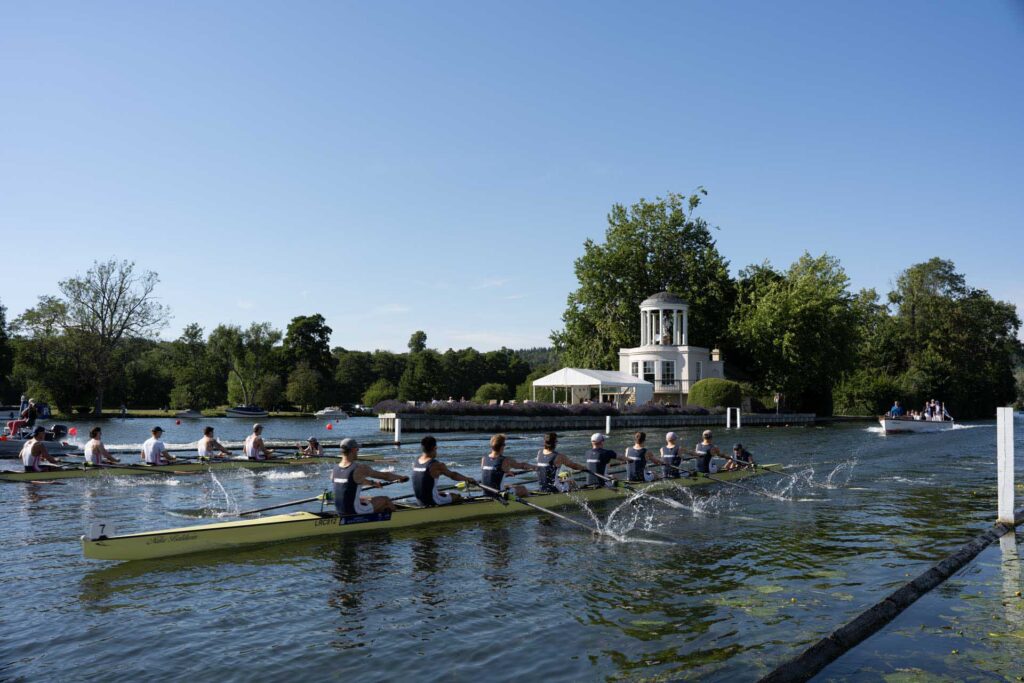






The Viltrox AF 35mm F1.2 LAB N FE is not a lens for photographers who want the smallest possible kit. At 910g, it is heavy for a 35mm prime and occupies a significant amount of space in a camera bag.
However, that size and weight bring an f/1.2 maximum aperture, robust metal construction and optical performance that stands up well on a high-resolution camera.
The Viltrox AF 35mm F1.2 LAB N FE produces very sharp images, even at its maximum aperture. The corners are also good, while distortion and chromatic aberration are controlled extremely well. There is some vignetting at the widest apertures, but it is gradual and has largely disappeared by f/2.8.
More importantly for a lens of this type, the Viltrox AF 35mm F1.2 LAB N FE produces smooth and attractive background blur. Its 35mm focal length allows you to retain a sense of place while using the shallow depth of field to guide attention towards your subject.
The autofocusing is fast and accurate on the Sony A7R VI and works well with the camera’s subject and eye detection. During the music gig, this gave me the confidence to use f/1.2 while concentrating on the composition and timing rather than repeatedly checking the focus.
The dedicated aperture ring makes the N FE version the more sensible choice for many Sony photographers. Its clickless option is useful for video and the physical markings make the aperture easy to check at a glance.
I would like an aperture ring lock and better support for both function buttons – although the latter is an issue for Sony to address. The visible focus breathing may also concern videographers who regularly make focus pulls during a shot.
Nevertheless, the Viltrox AF 35mm F1.2 LAB N FE offers an appealing combination of low light capability, subject separation, sharpness and handling. At £869, it also costs considerably less than some other large aperture 35mm lenses.
As a female photographer creating reviews for women who enjoy photography, I think it is important to be realistic about the weight. This is not a lens that disappears in your bag or feels effortless after several hours. However, for portraits, events, documentary photography and creative low light work, its results can justify carrying it.
During my testing, the Viltrox AF 35mm F1.2 LAB N FE gave me the type of images that make a large aperture 35mm lens so appealing: a sharp subject, a strong sense of atmosphere and beautifully softened surroundings.