
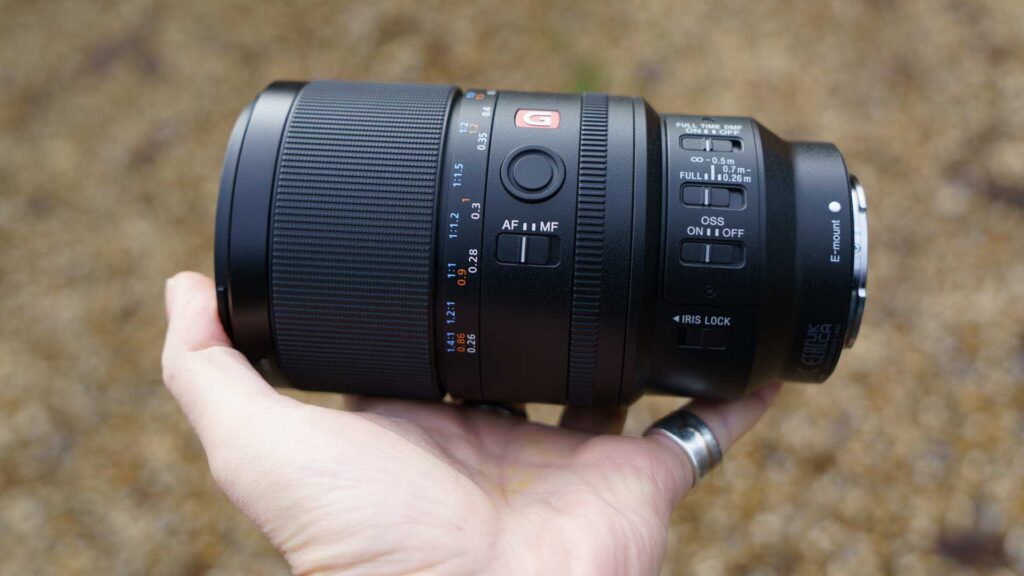
Sony’s G Master lenses are designed for photographers who expect a very high standard of performance, and with the FE 100mm F2.8 Macro GM OSS, macro photographers finally have a G Master option of their own. It builds on the FE 90mm F2.8 Macro G OSS, but adds several worthwhile upgrades, including 1.4x magnification, teleconverter compatibility, an aperture ring and a more advanced focusing system. It also delivers the high level of image quality that you would hope for from a premium macro lens, with excellent sharpness, attractive bokeh and a reassuringly solid build. Crucially, it feels well-suited to real-world close-up photography, with a control layout that makes it easy to switch between autofocus and manual focus as your subject demands. Although this lens is clearly aimed at macro photographers, it also has a lot to offer for portraits, still life and fine art photography.
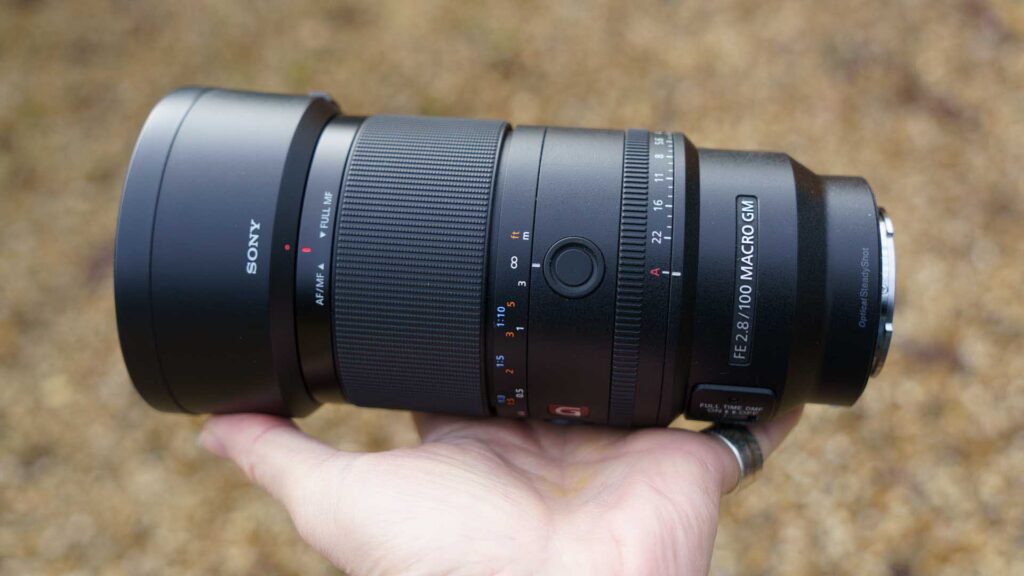
The Sony FE 100mm F2.8 Macro GM OSS is a mid-telephoto macro prime lens designed for Sony’s full-frame Alpha E-mount cameras. It’s the first true macro lens in the G Master range and it builds on the FE 90mm F2.8 Macro G OSS, bringing a little more reach, higher magnification and a high-end focusing system. As well as offering 1.4x magnification on its own, the lens is compatible with Sony’s optional teleconverters, taking the maximum magnification to 1.96x with the 1.4x teleconverter or 2.8x with the 2x converter. That makes it a very flexible option for photographers who want to shoot tiny subjects larger in the frame while retaining a comfortable working distance. Along with its close-up credentials, the Sony FE 100mm F2.8 Macro GM OSS is also suitable for portraits, still life and other short telephoto shooting.
The Sony FE 100mm F2.8 Macro GM OSS is priced at £1,400 / €1,600 / $1,498 and went on sale in November 2025. That places the lens in line with Sony’s premium G Master optics rather than standard macro lenses, and its specification reflects that.
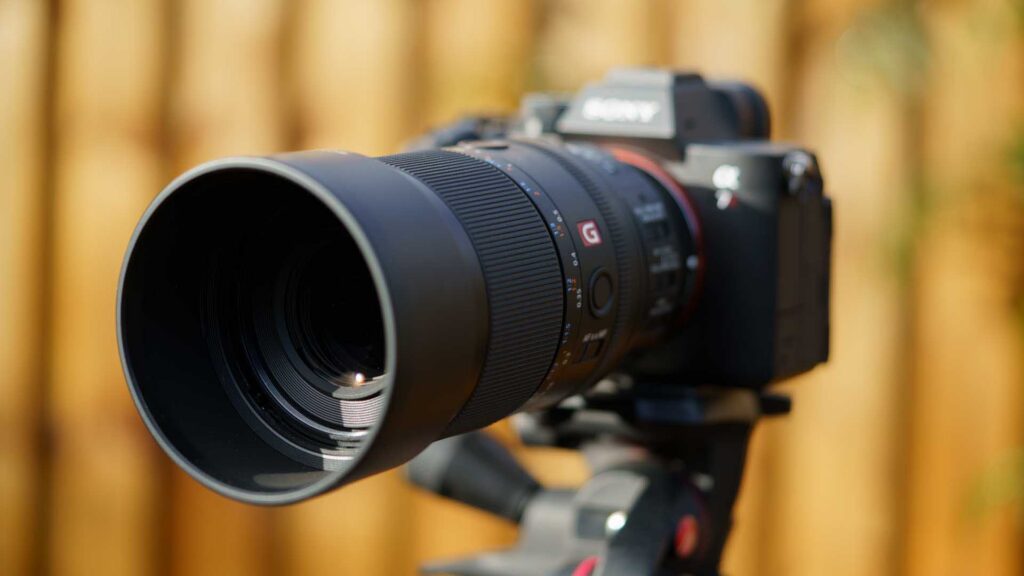
One of the headline features of the Sony FE 100mm F2.8 Macro GM OSS is its 1.4x maximum magnification at the minimum focusing distance of 26cm. That is more than the 1:1 reproduction ratio delivered by most true macro lenses, and it means you can fill the frame with even smaller details. When paired with Sony’s optional 1.4x or 2x teleconverters, the magnification can be pushed to 1.96x or 2.8x, giving even more scope for photographing insects, jewellery, textures and tiny still life subjects. Helpfully, the closest focusing distance does not change dramatically when a teleconverter is mounted, but at maximum magnification, you are still working very close to the end of the lens hood, so you need to be careful not to cast shade over your subject.
The optical construction consists of 17 elements in 13 groups, with two XA (extreme aspherical) elements and two ED (extra-low dispersion) elements. These are designed to reduce aberrations and maintain a high level of sharpness across the frame. There is also a floating focus mechanism to help keep image quality high throughout the focus range, which is especially important with a macro lens.
Sony has applied Nano AR Coating II to help suppress flare and ghosting, which is useful if you are shooting reflective subjects or working in backlit conditions. That may sound like a small point, but it matters with close-up work because shiny surfaces, highlights and awkward light angles are common.
The focusing system uses four XD (extreme dynamic) Linear Motors, and Sony says this arrangement delivers autofocus performance that is up to 1.9x faster than the older FE 90mm F2.8 Macro G OSS. The lens also supports full-time DMF (direct manual focus), which means you can adjust the focus manually while the lens is set to autofocus.
The onboard Optical SteadyShot (OSS II) stabilisation has been designed specifically for macro photography and works with in-body stabilisation to provide 6-axis correction. This includes compensation for front-to-back movement, which becomes increasingly problematic as you move to higher magnifications.
The f/2.8 maximum aperture and 11-blade circular diaphragm are intended to help produce smooth, attractive background blur, while the minimum focusing distance of 26cm (from the sensor) means you can get extremely close to your subject.
A 67mm filter thread keeps filter costs fairly reasonable for a lens of this type, and Sony supplies the lens with the ALC-SH173 hood plus front and rear caps.
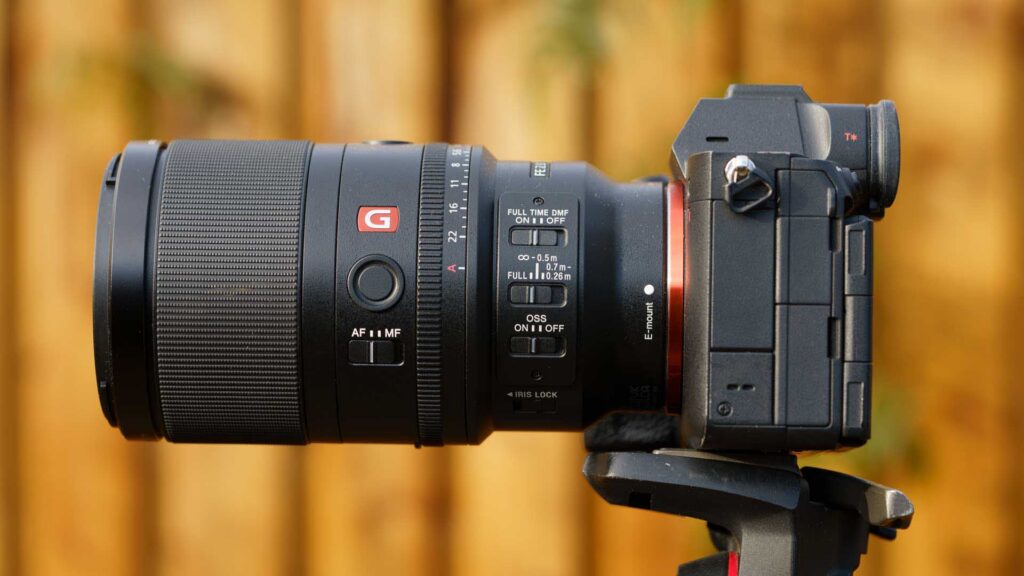
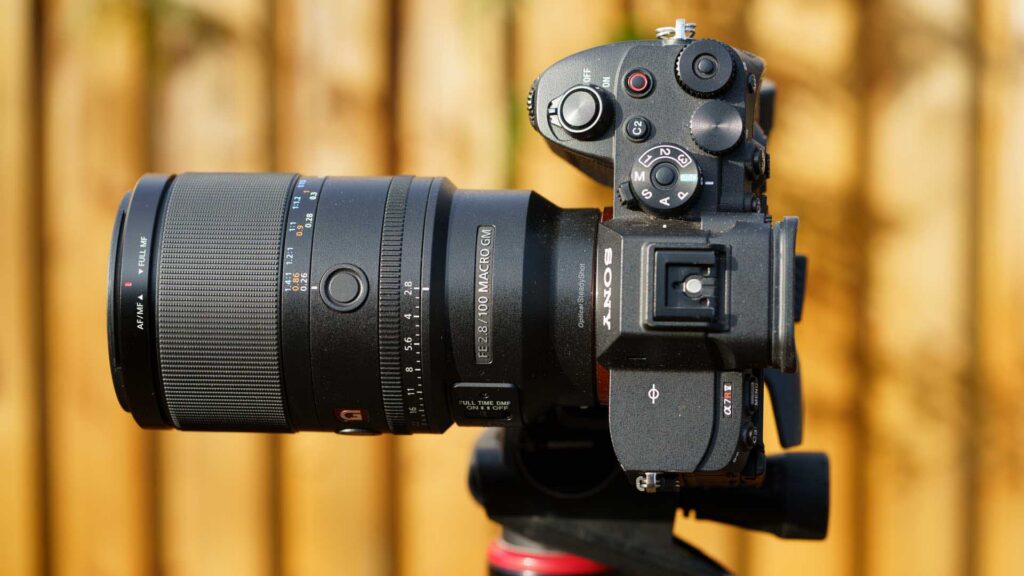
At 646g, the Sony FE 100mm F2.8 Macro GM OSS feels solid and substantial without becoming burdensome, and it balances nicely on a camera such as the Sony A7R V. Measuring 147.9mm in length and 81.4mm in diameter, it is not a small lens, but it’s very manageable in use. The build quality feels appropriate for a G Master optic, with dust and moisture-resistance plus a fluorine coating on the front element to help repel moisture and dirt.
The lens looks and feels good in the hand, but more importantly, Sony has thought carefully about how photographers actually focus at close distances. Like the FE 90mm macro lens, it has a push-pull clutch mechanism to switch between autofocus and manual focus. Pull the wide focus ring back towards the camera and manual focus is engaged, complete with physical end stops and a distance scale with magnification markings. Push the ring forwards, and you are back in autofocus mode.
This matters because a proper mechanical-feeling manual focus action with end stops is genuinely useful for macro photography. It makes focusing feel consistent and predictable, which is exactly what you want when depth of field is wafer-thin and the smallest movement can shift the point of focus significantly.
Sony has also included an AF/MF switch on the barrel, but this works differently. Using that switch activates focus-by-wire manual focus, which means there are no physical end stops or distance scale. Both approaches have their uses, but because they feel so different, there is a slight learning curve. The clutch system is the one I prefer for close-up work because it feels more deliberate and repeatable.
Whichever manual focus method you use, the focus ring itself is very nicely judged. It moves smoothly with a good degree of tension. It is loose enough for subtle, jerk-free adjustments with the light touch of one finger, but it never feels slack. That balance is very important for macro work, where tiny refinements to focus can make all the difference.
The focus controls do not stop there. There is also a full-time DMF on/off switch, which allows you to adjust focus manually when the lens is set to autofocus. I find that especially useful with macro photography because the autofocus system can get you to roughly the right point quickly, then you can take over and place the sharpest area exactly where you want it. It works particularly well when paired with Sony’s Auto Magnifier in MF setting, which enlarges the area under the selected AF point as soon as the focus ring is moved.
There is also a focus limiter switch on the lens barrel, and it can be set to full, infinity to 0.5m or 0.7m to 0.25m. These options are genuinely useful because they help restrict the range through which the autofocus system searches. That can make focusing quicker and more decisive when there are distracting objects in front of or behind your intended subject or when you are working in cluttered scenes.
The only switch on the left side of the lens barrel is the click on/off switch for the aperture ring. I prefer to use the aperture ring with clicks for stills because it makes it easier to keep track of how far I have changed the setting, but the de-click option is essential if you want to make smooth, silent aperture changes for video. The ring itself feels very well made and it works nicely in both settings.
Overall, the control layout feels logical and well-suited to close-up work. Sony has not overloaded the barrel with unnecessary controls, but the key ones are all there, and they are all useful.
I have used the Sony FE 90mm Macro G OSS extensively and, while it has served me well, its focusing can be a little ponderous. The FE 100mm F2.8 Macro GM OSS is clearly better in this respect. Its autofocusing is fast and accurate, and I find it helps the camera make more decisive focusing choices.
That is especially helpful with macro photography because the shallow depth of field means you often want to use a small focus area and place it very precisely. In most cases, I found the Sony A7R V and FE 100mm F2.8 Macro GM OSS get the subject sharp, but I still find the direct manual focus option valuable for finessing the final point of focus.
The faster focusing speed of the new lens means the camera is capable of tracking subjects more effectively than with the FE 90mm macro. Macro lenses are not usually the first choice for action, but the improved focusing performance makes this lens more versatile. Sony says it can support tracking at up to 120fps on the Alpha 9 III, which underlines that this is a much more advanced focusing system than the one in the older 90mm lens.
Of course, the Sony FE 100mm F2.8 Macro GM OSS is not limited to macro subjects. It also works very well for portraits and general moderate telephoto photography. I used it to photograph a band in a dimly lit pub and it performed well there too, locking focus reliably on an eye and giving pleasing separation between the subject and the background.
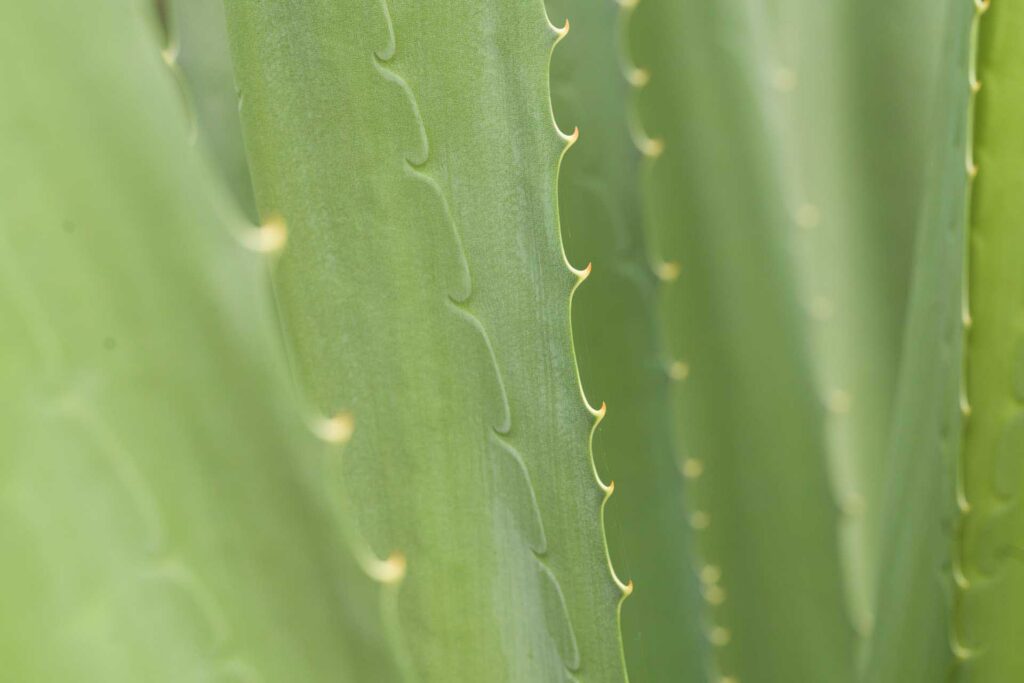
The Sony FE 100mm F2.8 Macro GM OSS is capable of producing impressively sharp images with a very high level of detail. Mounted on the 61MP Sony A7R V, it resolves plenty of fine detail and gives images a crisp, clean look.
Centre sharpness is very good at f/2.8, and it improves a little at f/4 before reaching its peak around f/5.6. Sharpness remains very strong through to f/11. I noticed a slight decline at f/16 and f/22, which is what you would expect as diffraction starts to have more of an influence, but at normal viewing sizes it is not troubling.
As usual, the corners are not quite as sharp as the centre with the aperture wide open, but they improve nicely at f/4 and sharpen further at f/5.6. By the time you reach the middle apertures, the lens is delivering a very high standard of sharpness across the frame.
Chromatic aberration is well-controlled and I did not spot any fringing in my images, even in high-contrast areas. Distortion is also very well corrected and I could not see any curvilinear distortion in my test images.
Vignetting is present at f/2.8, but it is not especially problematic. If you compare images shot at different aperture settings, you can spot a little corner shading when the aperture is wide open, but it improves at f/4 and has effectively disappeared by f/5.6.
The Sony FE 100mm F2.8 Macro GM OSS also produces attractive bokeh. The background blur is smooth and the transitions from sharp to unsharp areas are handled nicely. Small out-of-focus highlights look clean and rounded in the centre of the frame, with just a faint trace of a soap-bubble effect in some situations. Towards the edges of the frame, those highlights become a little more cat’s-eye shaped, which is fairly typical, but it is not especially distracting. Overall, the out-of-focus rendering is pleasing and helps subjects stand out well from their surroundings.
The stabilisation system is also effective. While a tripod is still the best option for critical macro work, I was able to achieve usable handheld results at shutter speeds as low as 1/13 sec. Around a quarter of my images were sharp at that speed, increasing to roughly 40% at 1/25 sec. That is very useful when you want to work a little more spontaneously or do not have a tripod to hand.
The lens also works very well with Sony’s teleconverters. Even with the 2x teleconverter mounted and the magnification increased to 2.8x, image quality holds up well. That is good news if you want to push in even closer without giving up too much in terms of sharpness and clarity.
Follow the link to browse and download full-resolution images from the Sony FE 100mm F2.8 Macro GM OSS. Please respect our copyright.









Sony has done a very good job with the FE 100mm F2.8 Macro GM OSS. It takes the FE 90mm Macro G OSS as a starting point and improves on it in several worthwhile ways. The 1.4x magnification opens up more creative possibilities than a standard 1:1 lens, and the option to use teleconverters extends that flexibility even further.
The focusing system is also a clear step forward. The autofocus system is faster and more decisive than the one in the FE 90mm macro, and the combination of autofocus, DMF and the clutch mechanism for manual focus gives you a lot of control over how you work. That flexibility is important with macro photography because every subject, shooting distance and lighting set-up can call for a slightly different approach.
I also like the addition of an aperture ring because I find it the quickest and easiest way to adjust the aperture size.
Most importantly, the image quality is excellent. The Sony FE 100mm F2.8 Macro GM OSS delivers impressive sharpness, attractive bokeh and good control over distortion, flare and chromatic aberration. The handling is also very good, with a layout and feature set that make real sense for close-up photography.
For Sony users who are serious about macro photography, this is a very compelling lens. As a small female photographer, I appreciate how balanced and intuitive it feels in use, and how easily it adapts to different ways of shooting. It is expensive, but it delivers the level of performance you would expect from a G Master lens, and it feels like a genuine upgrade rather than just a modest refresh.