
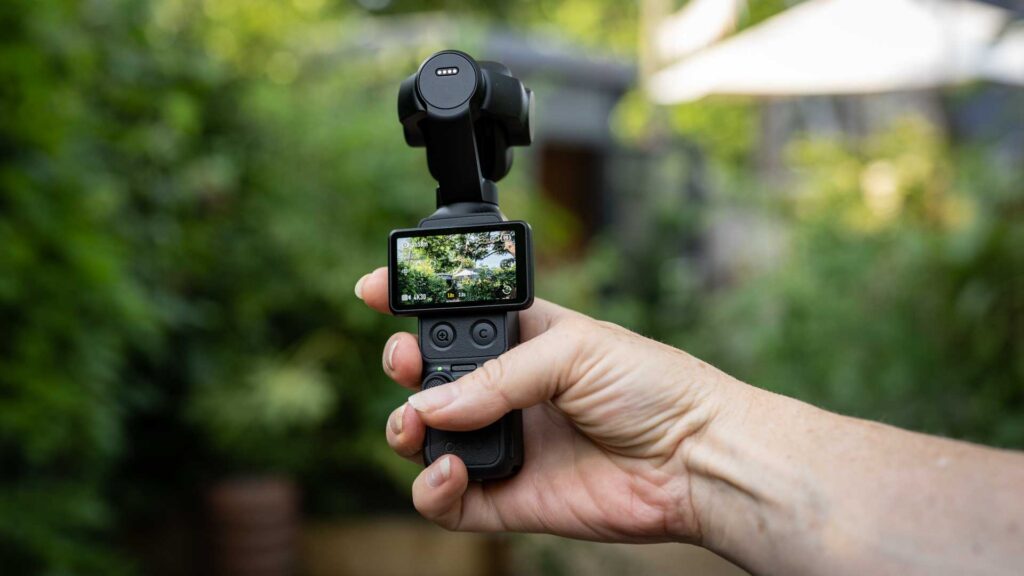
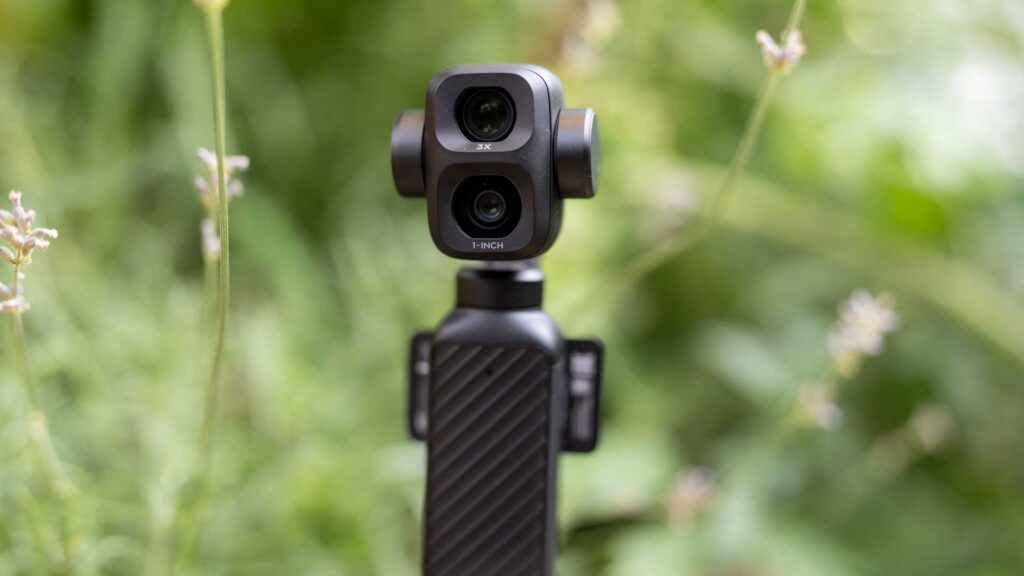
DJI has made the familiar Pocket concept considerably more versatile by adding a second camera. The Osmo Pocket 4P combines a 20mm wide-angle camera with a 60mm medium telephoto camera, each with its own sensor and lens. This gives you two optical viewpoints in one compact handheld camera rather than relying on digital cropping or interchangeable lenses.
Multiple built-in cameras aren’t new territory for DJI. Several of its drones feature two or three cameras to provide different focal lengths and the Pocket 4P brings the same thinking to a device that slips easily into a pocket or handbag.
The 20mm f/2.0 camera, with its 1-inch type sensor, is ideal for vlogging, travel and wider scenes. The 60mm f/1.8 camera uses a 1/1.28-inch type sensor and provides a tighter perspective without cropping the wide-angle image. It’s especially useful when filming people because you don’t have to stand uncomfortably close and the longer focal length gives a more flattering perspective with less distortion.
Image quality is excellent from both cameras, while the built-in 3-axis gimbal smooths out movement remarkably well. I’m certainly not the most polished run-and-gun videographer, but the Pocket 4P is very forgiving and removes much of the bounce and shake from handheld footage.
Its 4x slow motion also produces lovely smooth results. The 8x setting pushes things a little too far, however, with softer detail and reduced dynamic range.
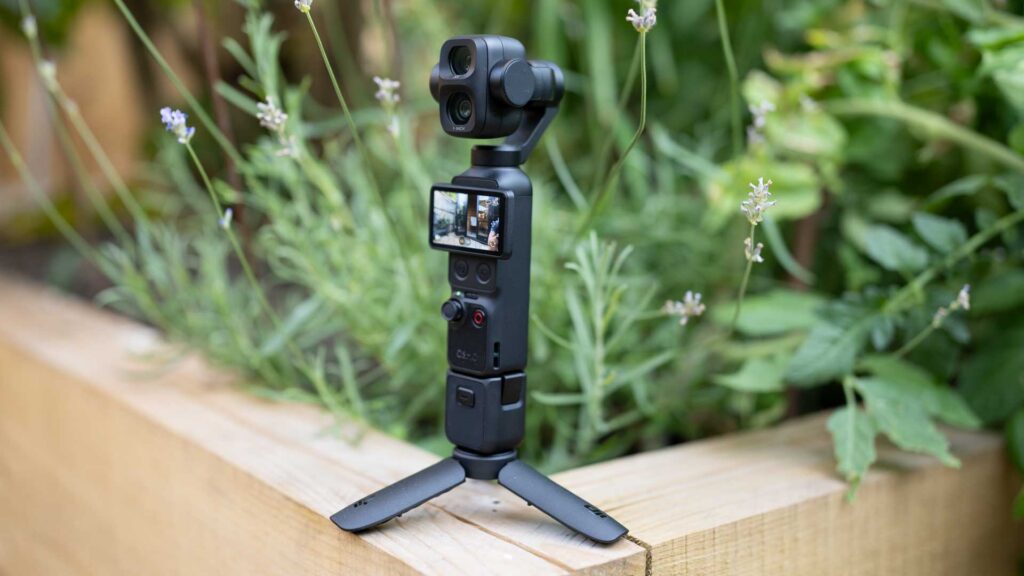
The DJI Osmo Pocket 4P follows the camera-on-a-stick design of earlier Pocket models. It’s a compact handheld camera with a built-in 3-axis mechanical gimbal, designed primarily for creating smooth, high-quality video. It can also capture high-resolution stills, but its biggest strength is making polished video accessible without carrying a large camera and separate stabiliser.
Its most significant upgrade is the dual-camera system. One camera pairs a 20mm equivalent f/2.0 lens with a 1-inch type CMOS sensor. The other uses a 60mm equivalent f/1.8 lens and its own 1/1.28-inch type CMOS sensor.
The wider camera suits vlogging, travel and situations where you want to include plenty of the surroundings. The 60mm camera is better for filming people, picking out details and working when you can’t move closer to your subject.
The Pocket 4P records video at up to 4K resolution, captures still images of around 37 million pixels and features a rotating 2-inch touchscreen, three built-in microphones, 103GB of internal storage and support for microSD cards up to 1TB.
Read our DJI Osmo Pocket 4 Review
The DJI Osmo Pocket 4P Standard Combo costs £529, while the Vlog Combo is priced at £605.
Both versions are available directly from DJI and authorised retailers in either classic black or pearl white.
DJI also offers Care Refresh protection. A one-year plan includes up to two replacements while the two-year plan covers up to four replacements for accidental damage, including collisions and water damage, subject to a replacement fee.
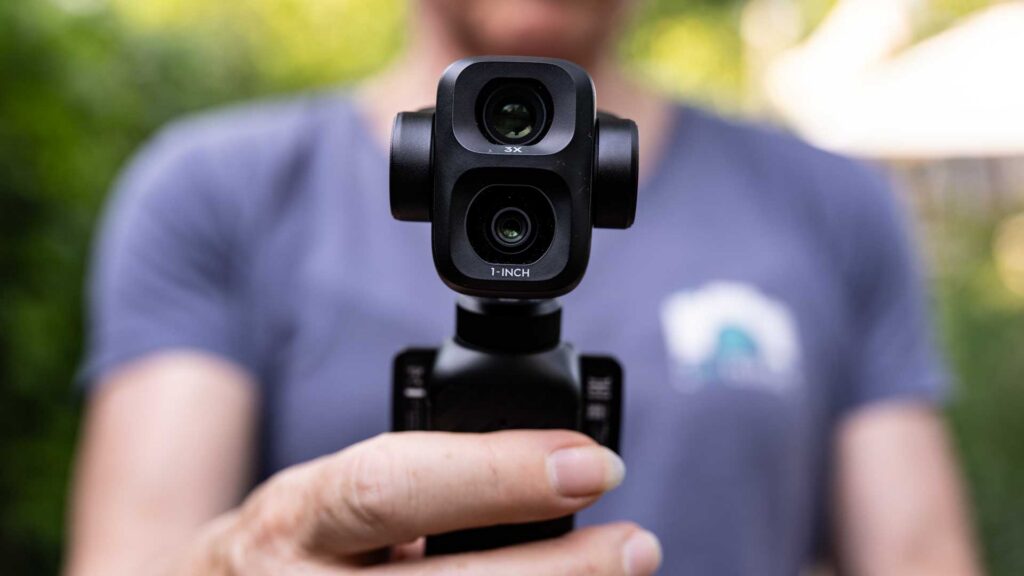
Without doubt, the dual-camera system is the Pocket 4P’s standout feature and the main reason to choose it over the Osmo Pocket 4. Each camera has its own sensor and lens, giving you two true optical focal lengths rather than digital crops.
The 20mm equivalent camera has an f/2.0 aperture, a focus range of 20cm to infinity and a 1-inch type CMOS sensor. Alongside it is the new 60mm equivalent camera with an f/1.8 lens, a 30cm minimum focusing distance and a 1/1.28-inch type CMOS sensor.
Specifications differ slightly between them. The 20mm camera has an ISO range of 100 to 25,600 for standard stills and video, increasing to ISO 51,200 in Low-Light Video mode. The 60mm camera starts at ISO 50 and reaches ISO 12,800, extending to ISO 25,600 in Low-Light Video mode.
According to DJI, the larger sensor uses lateral overflow integration capacitor (LOFIC) technology to deliver up to 17 stops of dynamic range in supported modes. Whether you’ll ever measure that in everyday use is another matter, but the Pocket 4P produces footage with plenty of detail, good tonal range and attractive colour.
Its recording options include 4K, vertical 3K video, Full HD and several slow-motion settings. The maximum frame rate depends on the camera in use. The 20mm camera records 4K at up to 240fps, while the 60mm camera reaches 200fps. Both can shoot Full HD at up to 240fps.
DJI has also added a 10-bit D-Log 2 colour profile for anyone who wants more flexibility when colour grading. That may appeal to experienced video creators, although it adds a layer of faff that feels slightly at odds with a camera designed to be quick and easy to use.
ActiveTrack 8.0 can recognise people, pets and vehicles, then adjust the framing as they move. Gesture Control also allows you to start recording or activate tracking without touching the camera.
The zoom system combines the two optical viewpoints with digital magnification. Digital zoom extends the reach to 9x for stills and 12x for video, although it isn’t available in every mode.
Hyperlapse, Timelapse and Motionlapse are also included, with Motionlapse supporting up to four programmed camera positions.
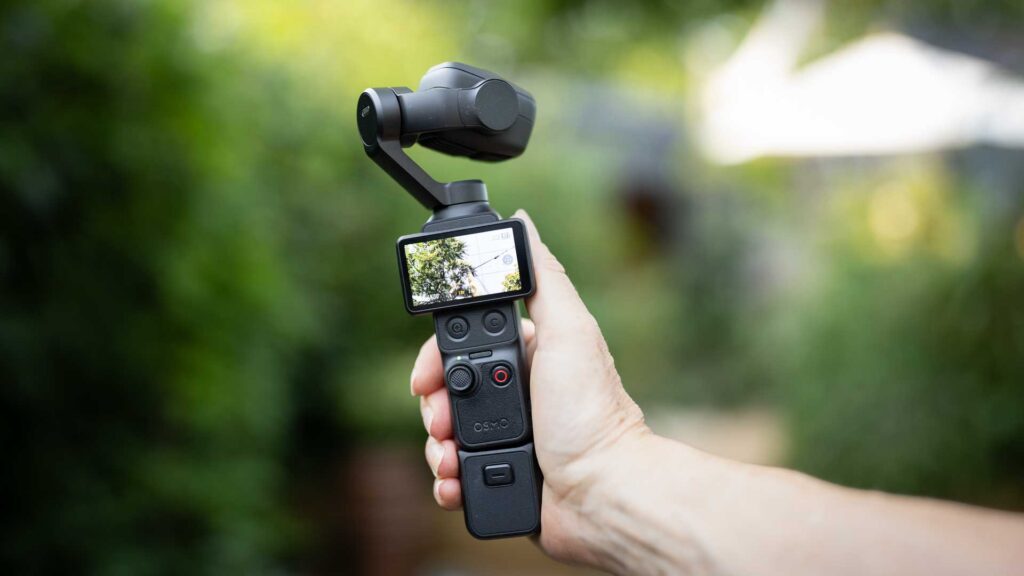
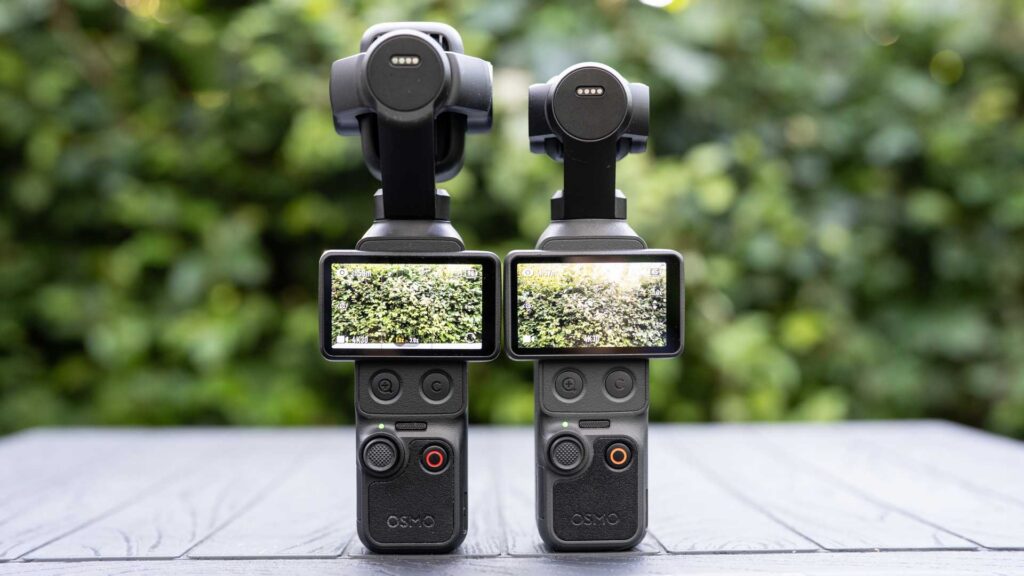
Although the DJI Osmo Pocket 4P is compact, it doesn’t feel quite as tiny as previous Pocket models. The handle section is the same size as the Pocket 4’s, but the camera and gimbal assembly is inevitably larger to accommodate two cameras.
What I noticed immediately is that most of the additional weight is in the upper section. As a result, the Pocket 4P feels slightly top-heavy in the hand. If you swap directly from the Pocket 4 to the Pocket 4P, you’ll notice the change. Initially, I compensated for this extra weight at the top by using the supplied mini tripod to extend the handle. However, after using the Pocket 4P for a relatively short time, I got over myself and used it without the tripod.
At 159.5 x 63.3 x 33.5mm and 230g, it’s still light enough to carry in a handbag or coat pocket. As a female photographer who sometimes travels with a relatively small bag rather than a full camera backpack, that’s a big part of its appeal. It’s always with you and ready to capture a moment without feeling like another piece of heavy camera kit. And of course, it’s also small enough to slip in amongst a large bag full of camera gear.
The built-in 3-axis mechanical gimbal is the Pocket series’ biggest advantage. Rather than relying solely on electronic stabilisation, it physically moves the camera to smooth out movement. DJI quotes a controllable pan range of -235° to 58°, a tilt range of -125° to 58° and a roll range of -45° to 45°, with a maximum controllable speed of 180° per second.
By default, the camera powers up when you rotate the 2-inch touchscreen from its vertical position into landscape orientation. If you want to start shooting even faster, you can set it to begin recording automatically as soon as the screen is flipped. Helpfully, recording doesn’t actually start until the camera is facing forwards, so you don’t end up with footage of your face or the area to the side of the camera while the gimbal swings into position. It’s a thoughtful touch that makes it much easier to capture fleeting moments.
The 2-inch touchscreen has a resolution of 556 x 314 pixels and provides a clear, bright view for composing shots and changing settings. However, there’s no escaping the fact that it’s a small screen. It’s perfectly usable, but it can be tricky to check fine details or confirm critical focus.
If that’s an issue for you the Pocket 4P can connect wirelessly to your smartphone using the DJI Mimo app, allowing your phone to act as a much larger monitor. It works well and makes it much easier to see what you’re recording, but once you add a phone to the setup it inevitably becomes a little more cumbersome, and your hands are full. Part of the Pocket’s appeal is its simplicity, so I rarely reached for my phone when I’m using it.
By default, the Pocket 4P records in the same orientation as the screen. Rotate the display and it switches between landscape and portrait recording, although you need to tap ‘Continue’ on the screen to stop the camera powering down, making it very easy to create content for YouTube Shorts and Instagram Reels or TikTok.
The joystick can either control the movement of the gimbal or operate the zoom. When controlling the gimbal, it gives you precise control over where the camera is pointing, making it easier to compose shots or create slow camera movements. Alternatively, it can be assigned to zoom control for smooth changes in framing. I found it very easy to switch between the two functions with a quick tap on the touchscreen.
DJI has also added a dedicated zoom button. A single press switches between the 20mm and 60mm cameras, while a second press returns to the wider view. Double-pressing jumps to the 6x digital zoom setting, with additional zoom available using the joystick once it’s assigned to that function. It all becomes second nature very quickly.
Read our Review of the DJI Mic Mini 2
Importantly, the image quality is excellent from both cameras for stills and video. The colours are attractive without looking over-processed, while detail and tonal range are impressive for such a small camera.
For vlogging and travel, the wider camera is the obvious choice. It includes plenty of the surroundings and gives you enough space to hold the camera at arm’s length while keeping yourself comfortably in the frame.
The longer lens comes into its own when I filming other people. It allows you to stand farther away, which feels less intrusive for the person in front of the camera. It also gives faces a more flattering perspective with less distortion.
It proves equally handy when a wall, flower bed, crowd or other obstacle prevents you from moving closer to your subject. Switching to the 60mm camera immediately produces a tighter composition without resorting to digital zoom.
I find the Pocket 4P’s autofocus system is generally very reliable with both cameras. Subjects are acquired quickly and remain sharp as they move around the frame.
The subject detection and tracking also work well, although occasionally a little too well. In a busy location, a passer-by can be identified as the new subject, prompting the camera to follow them instead of the person you intended. It’s easy to disable tracking when necessary.
There are four gimbal modes. Follow is the default and suited most of my shooting, responding naturally to movement while keeping footage smooth. Tilt Locked, FPV and FPV-1 provide alternative behaviour depending on how you want the camera to react, but Follow is likely to be the mode most people use most often.
The stabilisation is excellent. I’m not the most accomplished run-and-gun videographer and my walking technique is far from textbook-perfect, but the Pocket 4P is remarkably forgiving. It removes much of the bounce and shake from handheld footage without making movement look artificial.
Its 4x slow motion makes movement look graceful and helps disguise any remaining bounce. Water, animals, people walking and other everyday action can look impressively polished.
The 8x mode, however, is more of a compromise. Fine detail becomes softer and dynamic range drops, so subtle tonal transitions are lost. It’s useful when slowing the action is more important than ultimate quality, but I would usually stick with 4x.
Still image quality is also very good. Both cameras produce detailed, colourful images and the 60mm camera is particularly useful for isolating subjects or creating natural-looking portraits as its depth of field is shallower.
When set to Panorama mode, the Pocket 4P records either four or nine square images, moving the camera between each one before stitching them automatically. The four-image option produces a wide letterbox panorama, while the nine-image version creates a larger square composition.
Audio from the built-in microphones is good when you’re speaking close to the camera or want to record ambient sound. Nearby voices are clear and natural enough for casual vlogging or travel footage. However, an external microphone provides much better separation from background noise and one is included in the Vlog Combo.
The video below features 4K sample footage shot with the DJI Osmo Pocket 4P, using both the 20mm and 60mm cameras. It includes clips recorded at regular speed and in 4x slow motion, with a final example captured in 8x slow motion.
This next short video was captured using the DJI Osmo Pocket 4P and was edited in just a couple of minutes using the DJI Mimo smartphone app One-Tap Edit feature. No additional editing was done.
The DJI Osmo Pocket 4P is a thoughtful evolution of the Osmo Pocket concept. Instead of increasing specifications for the sake of it, DJI has added a second camera that genuinely changes how the device can be used.
The two focal lengths work well together. The wider view suits vlogging, travel and establishing shots, while the 60mm camera is better for people, details and situations where you can’t get closer.
Most significantly, the image quality is consistently impressive, the autofocus is reliable and the subject tracking works well. Meanwhile, the mechanical gimbal is one of the strongest reasons to buy an Osmo Pocket camera because it produces smooth, polished footage with very little effort.
While the DJI Osmo Pocket 4P can capture very good stills and create stitched panorama images, that’s not its main attraction. Its real strength is its video capability and the ease with which it enables you to capture smooth, high-impact footage almost anywhere. It’s the type of camera that encourages you to shoot more video because it removes many of the complications that can put people off.
There are compromises. The larger camera assembly makes it slightly more top-heavy than previous Pocket models and the 8x slow motion setting sacrifices more image quality than I’d like. Using a smartphone as an external monitor also makes the setup feel less elegant.
Those are relatively minor issues. At 230g, the Pocket 4P slips easily into a handbag or jacket pocket, although I’d dearly love DJI to include a gimbal and lens protector in the kit. As a female photographer, I particularly appreciate being able to create polished video without carrying a large camera, several lenses and a separate gimbal.
What I like most is that it makes shooting video feel easy. I’ve shot numerous videos on larger cameras, but the Pocket 4P is ready to record in seconds, forgiving in use and small enough to take on trips where I might otherwise leave a larger setup at home. For anyone who regularly shoots travel videos, vlogs, family moments or social content, the second camera makes the Pocket 4P a far more versatile creative tool than its predecessors.