
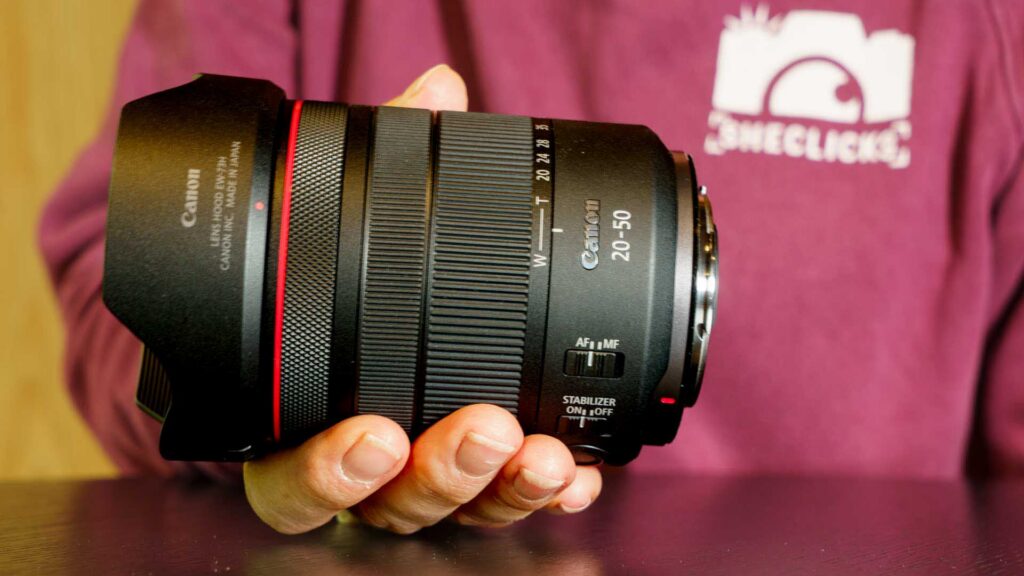
The Canon RF 20-50mm F4L IS USM PZ is an unusual lens in the best possible way. It combines the convenience of a compact standard zoom with the smooth control of a built-in power zoom system, making it particularly attractive for video creators who want more polished footage without moving into full cinema kit territory.
I used a production sample of the lens with a beta version of the Canon EOS R6 V but both already felt very refined. The internal power zoom is smooth and responsive, the autofocusing is fast and accurate, and the lens balances beautifully for handheld shooting and gimbal work. Canon’s decision to start at 20mm rather than the more typical 24mm also makes a noticeable difference for vlogging, interiors and establishing shots.
This is clearly a lens designed for creators who shoot both stills and video, but who lean more heavily towards video content. It feels purpose-built for Canon’s growing EOS V range while still delivering the robust build and image quality expected from an L-series optic.
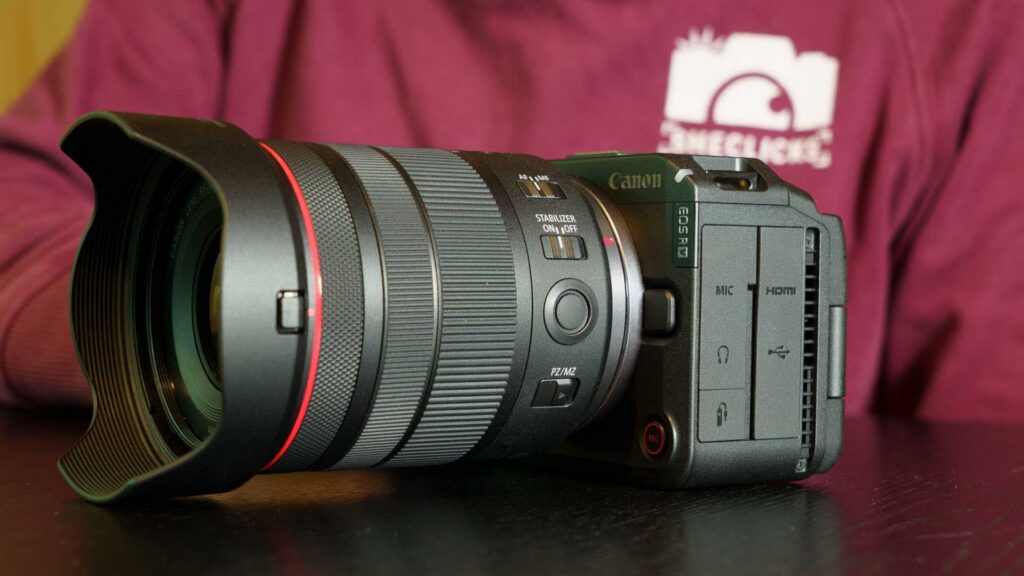
The Canon RF 20-50mm F4L IS USM PZ is a full-frame standard zoom lens for Canon RF mount cameras, and it is the first full-frame RF L-series lens to feature a built-in power zoom system.
It is aimed at hybrid creators and video shooters who want smoother, more controlled zoom movements than are possible with a traditional manual zoom ring. Canon has positioned the lens alongside the EOS R6 V, a new full-frame video-first camera aimed at content creators and solo filmmakers, but the lens is compatible with a broad range of RF mount cameras. It combines internal power zoom technology with Canon’s L-series optical design and weather-sealed construction.
Unlike larger cinema-focused zooms, the RF 20-50mm F4L IS USM PZ remains relatively compact at 420g while still offering optical image stabilisation, fast Nano USM autofocusing and a constant f/4 aperture throughout the zoom range.
Read Our Canon EOS R6 V Review
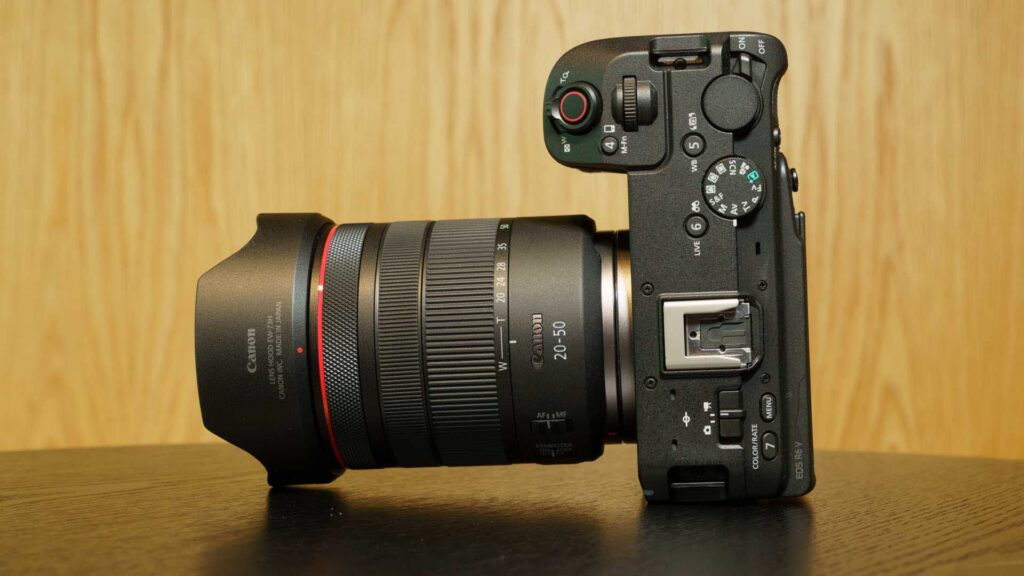
The Canon RF 20-50mm F4L IS USM PZ is priced at £1,439.99 in the UK and is scheduled to go on sale from 24 June 2026. It will also be available as part of a kit with the Canon EOS R6 V for £3,549.99.
The standout feature of the Canon RF 20-50mm F4L IS USM PZ is the integrated power zoom system. Unlike external power zoom adapters, the zoom motor is built directly into the lens body and uses Nano USM motors to deliver smooth, controlled zoom transitions while filming.
In practice, this allows much more fluid zoom movements than are possible with a traditional manual zoom ring.
The power zoom can be controlled directly from the lens, by compatible cameras with a zoom lever such as the EOS R6 V, or remotely via Canon’s Camera Connect app. Canon also confirmed that the zoom speed can be adjusted and multiple speed settings are available.
The 20-50mm focal length range is also an interesting choice. Starting at 20mm makes the lens much more useful for handheld vlogging and interiors than a traditional 24-70mm lens, while 50mm still gives enough reach for portraits, product details and tighter framing. That said, there are times when 50mm doesn;t seem quite enough.
Canon has constructed the RF 20-50mm F4L IS USM PZ from 13 elements in 11 groups, including two glass-moulded aspherical elements and three Ultra-low Dispersion (UD) elements to help control distortion and chromatic aberration. Air Sphere Coating (ASC) and Super Spectra coatings are also included to reduce flare and ghosting.
Canon has also included a fluorine coating on the front element to help repel moisture and fingerprints, something many photographers and filmmakers will appreciate when working outdoors.
The lens has a 9-blade diaphragm and a constant f/4 maximum aperture throughout the zoom range. Optical image stabilisation delivers up to 6 stops of compensation on its own or up to 8 stops when paired with a compatible camera featuring In-Body Image Stabilisation (IBIS).
Read Our Canon EOS R6 III Review
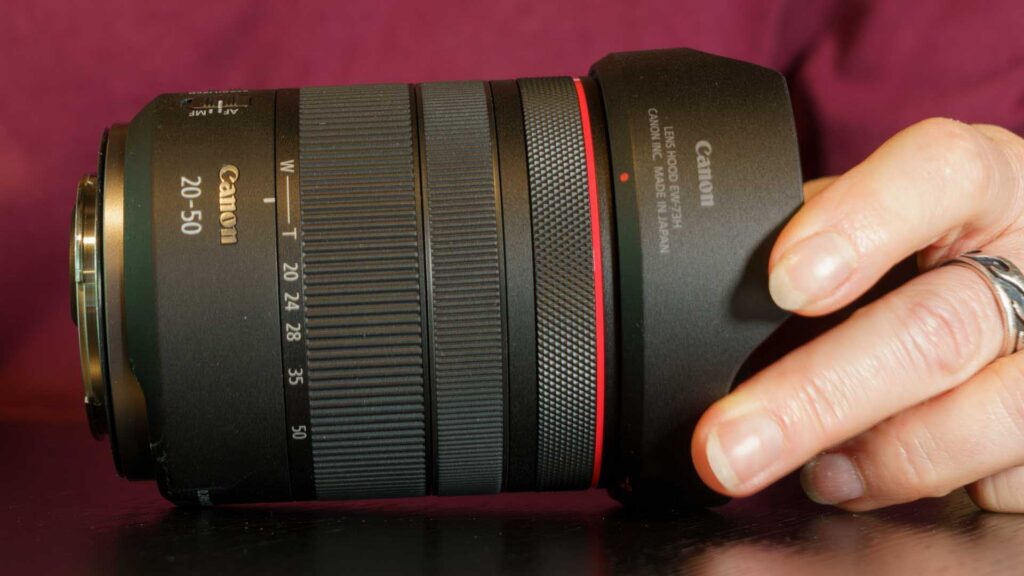
The Canon RF 20-50mm F4L IS USM PZ feels like an L-series lens. Despite being relatively lightweight at 420g, it has a reassuringly solid construction with dust and moisture resistance for shooting in more challenging conditions.
At 79.9 x 98.4mm, the lens balances well on single-grip full-frame mirrorless bodies. I used it on the EOS R6 V and the combination felt comfortable for handheld shooting. It also seems very well suited to gimbal work because the internal zoom design means the lens doesn’t extend while zooming, helping to maintain the balance.
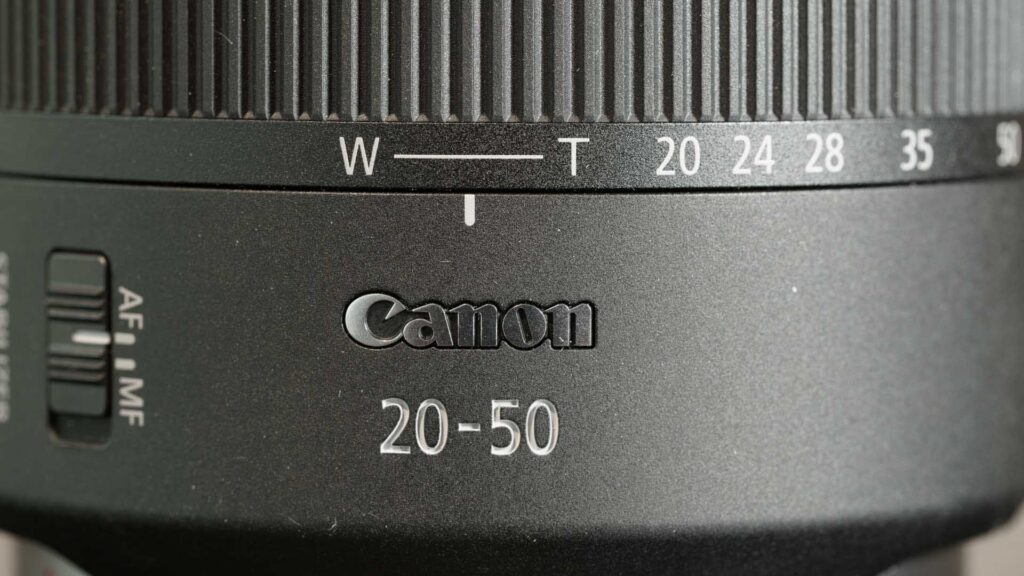
I find the control layout straightforward and practical. In addition to the usual focal length markings on the zoom ring, there’s an area marked W-T, which is where you get control over the power zoom. It’s simply a case of rotating the ring past the click point into the W-T section and then applying a little rotational pressure to zoom in or out. It feels intuitive very quickly and allows smoother, more controlled zoom movements than a traditional manual zoom ring. Even in manual zoom mode, the zoom mechanism remains electronically controlled, which gives the movement a consistent feel.
The lens also features a manual focus ring, a separate control ring and a customisable Lens Function button. The rings move with enough resistance to feel precise without becoming stiff.
One of the things I particularly like is how discreet the lens feels in use. It doesn’t attract attention in the same way that larger hybrid zooms often do, which I think many female creators and solo shooters will appreciate when filming in public places or while travelling. That’s partly because the lens is a 20-50mm f/4 rather than the more familiar 24-70mm f/4 or 24-70mm f/2.8.
Although I was only able to use the RF 20-50mm F4L IS USM PZ briefly with a beta sample EOS R6 V body, first impressions were very positive.
The autofocusing is quick and decisive, locking onto subjects smoothly during both stills and video shooting. The Nano USM autofocus system keeps focusing transitions looking natural and controlled, which is especially important for video creators filming themselves or moving between subjects.
The power zoom functionality is genuinely useful rather than feeling like a gimmick. Zoom transitions are smooth and steady, when controlled via the camera’s zoom lever or the lens ring. I find the electronic zoom can change the focal length much more smoothly and more slowly than I can manually, and it gives footage a more professional appearance compared with manually rotating a zoom ring.
Canon has also worked to suppress focus breathing, which helps maintain more stable framing while focusing or zooming. That should be welcomed by filmmakers and content creators alike, but I have yet to investigate it properly.
Image quality also looks promising. The lens produces crisp, contrasty results with pleasing sharpness across the frame. Starting at 20mm makes it easier to create more immersive wide-angle footage while avoiding the exaggerated distortion that can sometimes affect ultra-wide lenses.
The optical image stabilisation system appears to works well for handheld shooting and the compact design makes the lens feel very agile in use. The closest focusing distance is 24cm and the lens delivers a maximum magnification of 0.33x at 50mm, making it useful for filming products, food and detail shots.
Some photographers may prefer an f/2.8 aperture for lower light shooting or shallower depth of field, but for the intended audience of hybrid creators and video shooters, the smaller size and lighter weight are likely to be a worthwhile trade-off.
I will investigate further when I have a full-production sample for testing, but my initial impressions indicate that chromatic aberrations, curvilinear distortion, flare and vignetting are all kept under control well.
These images were shot using a production-sample Canon RF 20-50mm F4L IS USM PZ on a beta-sample Canon EPS R6 V, so the final image quality may vary.






The Canon RF 20-50mm F4L IS USM PZ feels like a very modern lens designed specifically for the way many creators now work. Rather than simply adapting a photography lens for video use, Canon has clearly thought carefully about what solo filmmakers, vloggers and hybrid shooters actually need.
The built-in power zoom works extremely well and makes it easier to capture smoother, more polished footage without extra accessories. Combined with the compact size, internal zoom mechanism and useful focal range, the lens feels especially well-suited to handheld filmmaking and travel content creation.
It is undeniably expensive for an f/4 standard zoom, and photographers who primarily shoot stills may still gravitate towards faster lenses. However, for creators who split their time between video and photography, the RF 20-50MM F4L IS USM PZ looks like one of the most interesting RF lenses Canon has introduced in some time.
The fact that Canon has brought power zoom technology into a compact full-frame L-series lens suggests this may only be the beginning of a broader move towards creator-focused hybrid optics. A built-in power zoom is much more attractive than an add-on. Based on this early hands-on experience, it is a very encouraging start.