
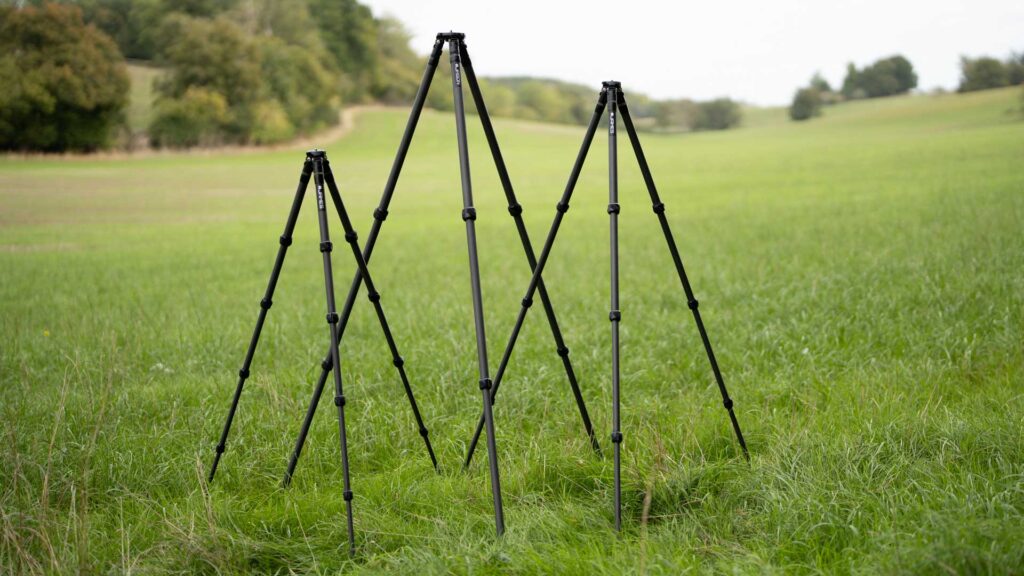
The 3 Legged Thing Modular Tactical Tripod System takes the company’s long-standing approach to interchangeable tripod components to a new level. With two canopies, three carbon fibre leg sets and a growing collection of feet and accessories, you can configure the tripod for anything from travel to landscape, wildlife or video and change it later if your needs alter. I particularly like that you don’t have to decide at the outset which type of tripod you’ll need for the next few years, you can start with the combination that suits you now and add to it later.
Visit the 3 Legged Thing Modular Tactical Tripod System Kickstarter Campaign
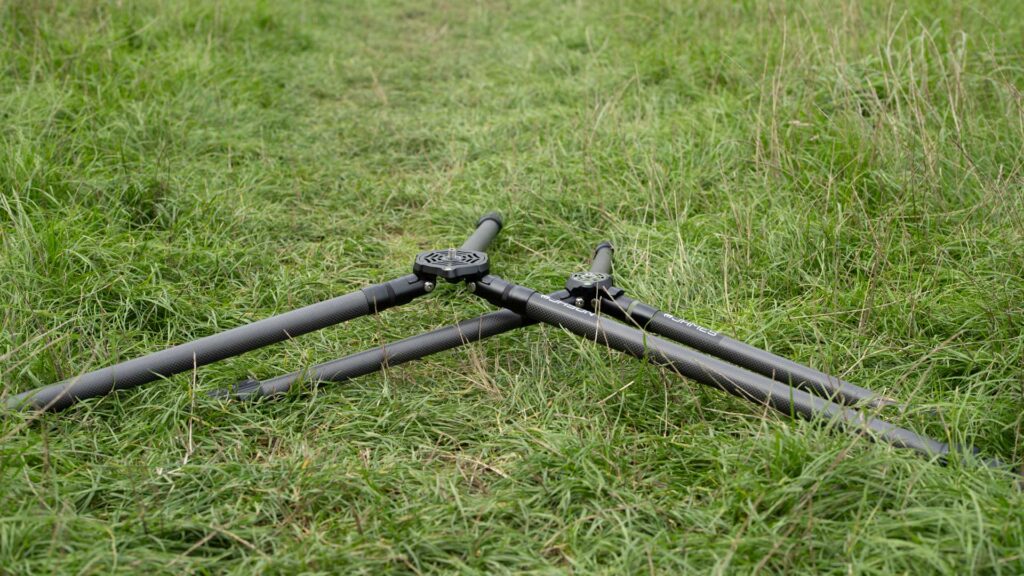
The 3 Legged Thing Modular Tactical Tripod System is a configurable camera support system built around two tripod canopies, three interchangeable carbon fibre leg sets and a collection of feet and accessories.
3 Legged Thing has always been a little different from many tripod manufacturers. Although it makes dedicated monopods, for example, it has also enabled photographers to create a monopod from one of the legs of a tripod. That originally involved one removable leg, but the idea has evolved and the company’s current tripods have three removable legs, each of which can be used as a monopod or boom. There are also interchangeable tripod feet for different surfaces and alternative short legs that convert compatible full-size tripods into table-top supports.
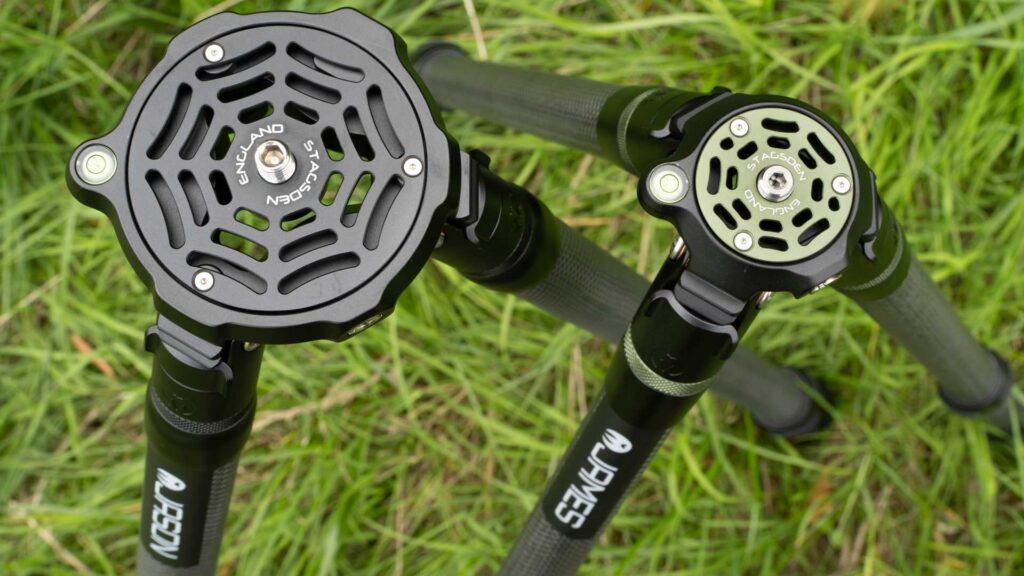
The Modular Tactical Tripod System takes that thinking a significant step further because the main structure of the tripod is interchangeable. There are two canopies called the James and the Jason. The James is the smaller of the pair and creates a slimmer tripod, while the Jason has a wider platform that is better suited to larger tripod heads and heavier setups. Either canopy can be combined with three, four or five-section legs and all three leg sets are made from eight-layer 3K weave carbon fibre.
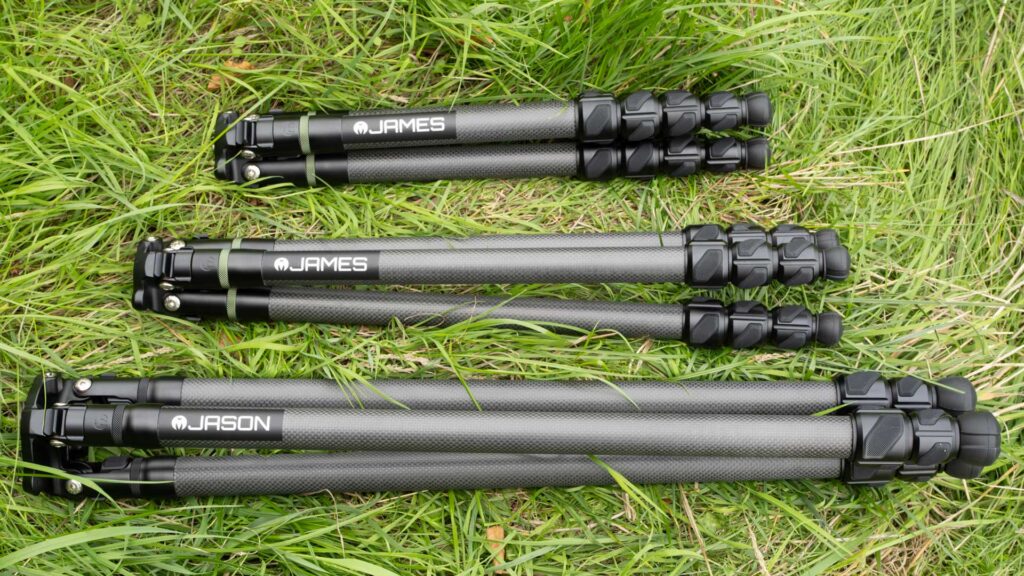
The five-section legs are the most travel-friendly option. They have tube diameters of 26, 23, 20, 17 and 14mm, collapse to 34.5cm in length and weigh 807g as a set. The four-section legs use 26, 23, 20 and 17mm tubes, pack down to 45cm and weigh 852g. Meanwhile, the three-section legs have larger 29, 26 and 23mm tubes, collapse to 60cm and weigh 1.083kg as a set.
This gives you six basic combinations before you start changing the feet or adding other accessories. You can have the James or the Jason with three, four or five-section legs, and you’re not stuck with that configuration after you’ve bought it. If you start with a five-section James because you want a small travel tripod, for example, you can add three-section legs later if you want a taller, more substantial support. Similarly, if you start using a larger camera, long lens or video head and want a wider platform, you can buy the Jason canopy and use it with the legs you already own.
Read Our 3 Legged Thing Axis 34 Strap Review
The 3 Legged Thing Modular Tactical Tripod System is available in the James and the Jason configurations, with the choice of three, four or five-section legs. The individual components can also be bought separately, which is an important part of the idea because you don’t have to commit to every possible configuration when you first buy into the system.
The James canopy costs £129.99 when bought separately, while the larger Jason canopy is £149.99. A complete set of three Modular Tactical Tripod System legs costs £249.99, whether you choose the three, four or five-section version.
That means you could buy a compact configuration now and add a different leg set later rather than buying a second complete tripod. Of course, if you get carried away and buy both canopies, all three leg sets and several types of feet, the cost soon mounts up, but I think this system makes much more sense if you regard it as something to build on as your photography changes.
The Spikez Long tripod feet cost £59.99 for a set of three while the QD Rig accessories start at £9.99. There are also replacement and alternative coloured parts. The rings at the top of the legs are available in black, orange and Olive Drab Green and the canopy mounting plates are available in the same colours. I’m hoping SheClicks Malbec might make it onto the colour chart one day.
| Leg sections | 3 |
| Maximum height | 154cm / 60.6in |
| Minimum height | 14.7cm / 5.7in |
| Folded length | 68cm / 26.7in |
| Weight | 1.4kg / 3.1lb |
| Maximum load | 30kg / 66lb |
| Leg material | Carbon fibre |
| Leg sections | 4 |
| Maximum height | 140.5cm / 55in |
| Minimum height | 11cm / 4.33in |
| Folded length | 52cm / 20.4in |
| Weight | 1.2kg / 2.65lb |
| Maximum load | 30kg / 66lb |
| Leg material | Carbon fibre |
| Leg sections | 5 |
| Maximum height | 123cm / 48.4in |
| Minimum height | 10.5cm / 4.1in |
| Folded length | 42.5cm / 16.7in |
| Weight | 1.17kg / 2.58lb |
| Maximum load | 30kg / 66lb |
| Leg material | Carbon fibre |
| Leg sections | 3 |
| Maximum height | 154cm / 60.6in |
| Minimum height | 15.6cm / 6in |
| Folded length | 68cm / 26.7in |
| Weight | 1.48kg / 3.26lb |
| Maximum load | 30kg / 66lb |
| Leg material | Carbon fibre |
| Leg sections | 4 |
| Maximum height | 140.5cm / 55in |
| Minimum height | 11cm / 4.33in |
| Folded length | 52cm / 20.4in |
| Weight | 1.28kg / 2.82lb |
| Maximum load | 30kg / 66lb |
| Leg material | Carbon fibre |
| Leg sections | 5 |
| Maximum height | 123cm / 48.4in |
| Minimum height | 11cm / 4.3in |
| Folded length | 42.5cm / 16.7in |
| Weight | 1.23kg / 2.7lb |
| Maximum load | 30kg / 66lb |
| Leg material | Carbon fibre |
Read Our 3 Legged Thing Axis Anywhere Review
The main feature of the 3 Legged Thing Modular Tactical Tripod System is, naturally, its modular construction, but there’s more to it than simply being able to change the legs.
The James and the Jason canopies are both made from magnesium alloy and measure 8cm high. The James has a maximum width of 9cm and weighs 356g while the Jason is 14cm across at its widest point and weighs 419g. The James is therefore the logical choice if you want to keep the tripod as slim and portable as possible, whereas the Jason gives a larger tripod head, clamp or other support a broader platform.
Both canopies accept all three leg sets and have a standard 3/8″-16 mounting thread for attaching a tripod head or other support. There’s also a bubble level, a 1/4″-20 accessory socket and a Quick Detach (QD) connection for compatible straps and accessories.
You can also add a QD socket to other kit using the QD Rig or QD Rig Long. The standard QD Rig weighs 14g, measures 2.3cm long and has a 1/4″-20 mounting screw with a 3/8″-16 sleeve adapter. The longer QD Rig Long weighs 35g, measures 5.1cm and has a longer 3/8″-16 screw for larger rigs and cages. It can also be used as a replacement mounting screw for the James.
The leg sets are what make the biggest difference to the way the tripod packs and handles. With the five-section set, you’re prioritising portability. Each leg weighs 267g and the complete set weighs 807g, while the 34.5cm folded length makes them the obvious choice for travel or days when you’ll be carrying the tripod for a long time.
Moving to the four-section legs increases the folded length to 45cm, but the set only weighs another 45g at 852g. Importantly, there’s one fewer joint and the narrowest tube is 17mm rather than 14mm. The four-section version therefore looks like the natural all-rounder in the range.
The three-section legs are the big ones. They weigh 1.083kg as a set, fold to 60cm and have larger diameter tubes. They extend to 159cm before the canopy and tripod head are taken into account, so they’re the option to look at when height and rigidity matter more than packed size.
Each individual leg has a 3/8″-16 thread at the top and can be removed from the canopy for use as a monopod or handheld boom. You can even remove one leg and leave the other two on the canopy if you want to use the system as a bipod.
Read Our 3 Legged Thing Axis Sling Review
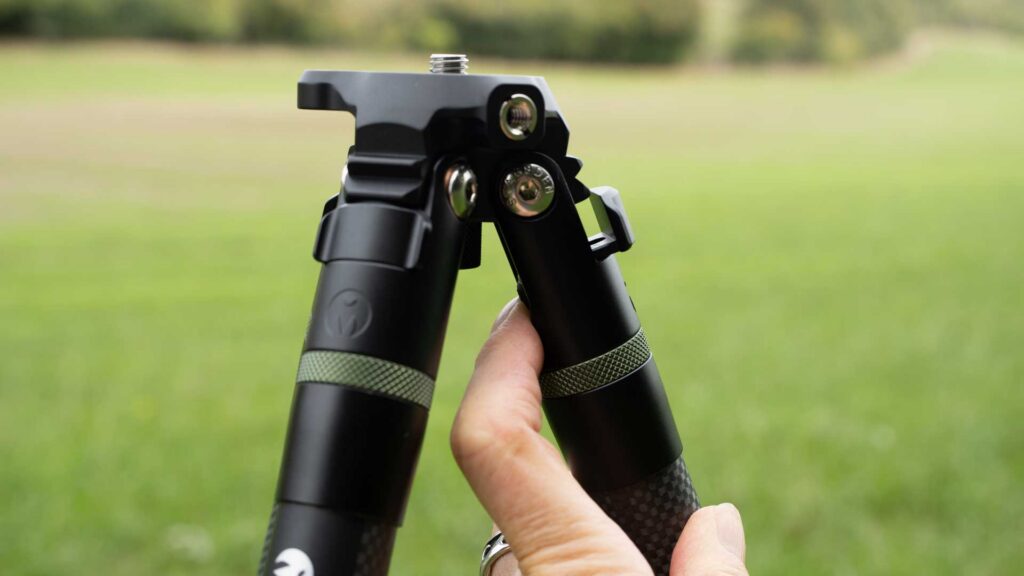
The leg angle adjustment has also changed from previous 3 Legged Thing tripods. Older models use pull-out adjusters that need to be pulled away from the canopy before you change the angle of the leg. They work, but they can be a little fiddly, particularly when you’re trying to reposition the tripod quickly. The new Trigger-Pull system is easier to use.
Each leg can be positioned independently at 23, 55 or 80 degrees. That’s useful when you’re working on steps, rocks, slopes and other uneven surfaces, while the 80 degree position lets you spread the tripod very wide for low-level photography.
Not having a centre column means it’s very quick to set the tripods to their lowest-shooting position. There’s no need to remove or reverse a column and your camera stays the right way up.
The ability to change the tripod feet isn’t new for 3 Legged Thing, but it makes even more sense as part of a system designed to be reconfigured.
The new Flatz interest me most. Each one has a broad 60mm diameter rubber base that spreads the load over a larger area than a conventional tripod foot. The complete set weighs 201g and each foot has a stainless steel stem with an articulating ball connection, allowing the rubber base to sit flat against the ground even when the tripod leg is angled.
They have a 1/4″-20 thread and come with 3/8″-16 sleeve adapters, so they can be used with a range of compatible supports. I’m particularly keen to use them for long exposures on sandy beaches because even a small amount of sinking during a lengthy exposure can spoil an image. They should also be useful on snow, grass and other soft surfaces.
Meanwhile, the Spikez Long tackle a different problem. These 84mm stainless steel spikes can dig into soft or uneven ground for extra grip and their additional length helps keep the ends of the tripod legs clear of mud and shallow water. Removable rubber covers fit over the spikes when you want to use them on a hard floor or table.
You can also attach the Spikez Long directly to compatible James or Jason canopies after removing the regular legs, creating a compact low-level or table-top tripod. It’s this sort of crossover between the different components that makes the system more interesting than simply having a choice of long or short tripod legs.
Read Our 3 Legged Thing AirHed Vision Review
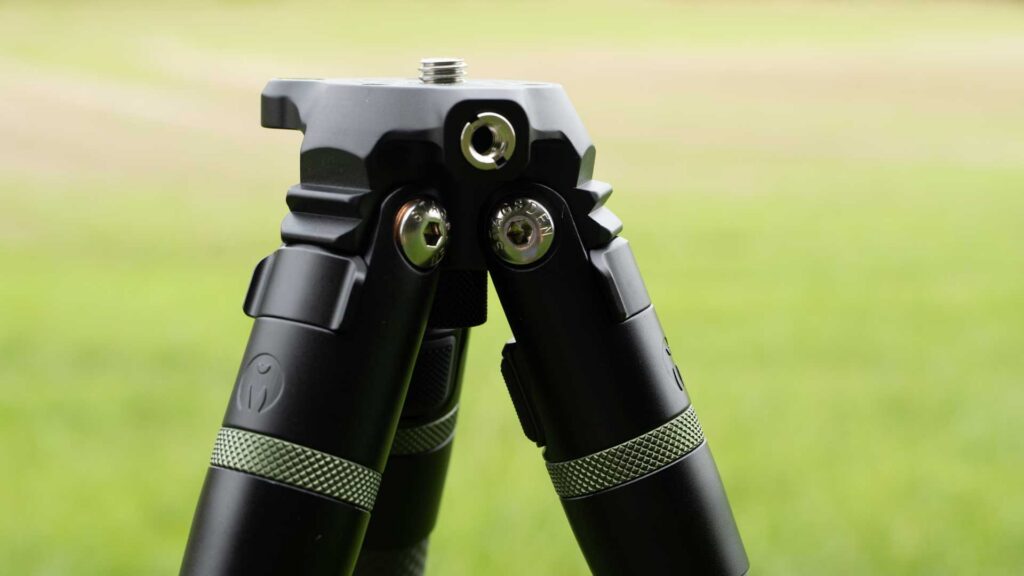
The Modular Tactical Tripod System feels very much like a 3 Legged Thing product. The leg tubes are made from eight-layer 3K weave carbon fibre, the canopies use magnesium alloy and stainless steel is used for fixings and components such as the stems in the Flatz feet. The legs can also be dismantled for cleaning, which is important if, like me, you regularly put a tripod into sand, mud or seawater.
The oversized leg locks have plenty of texture and are easy to grip, even when your hands are cold. They also use what 3 Legged Thing calls its Helical Strake design, which the company says channels airflow downwards to help root the tripod and dampen vibration. It’s an interesting idea, although I’m not sure how you could reliably isolate the effect of the lock shape from the other factors that affect tripod stability.
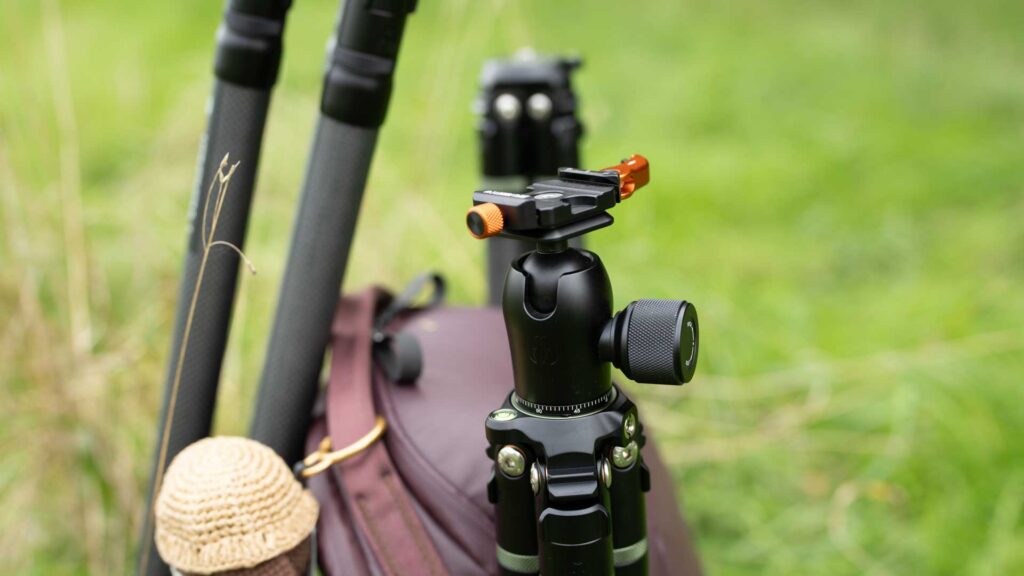
In day-to-day use, the number and diameter of the leg sections have a much more obvious effect. The five-section legs have more locks to operate but pack down dramatically smaller, and as a female photographer who’s often trying to fit a tripod into the side pocket of a backpack rather than strap it across the outside, that’s useful. The three-section legs are the opposite. They’re longer and heavier to carry, but if I’m heading out specifically to photograph landscapes in breezy conditions or use a substantial telephoto lens, that’s a compromise I’m likely to be happy to make. The four-section legs sit neatly between the two and I suspect they’ll be the default choice for many photographers.
The Trigger-Pull controls are another improvement I appreciate. As I mentioned earlier, on previous 3 Legged Thing tripods I’ve used, the pull-out leg angle adjusters can sometimes feel a little fiddly because you need to pull the control away from the canopy before repositioning the leg. With Trigger-Pull, I slip my index finger behind the control and squeeze the pad towards my finger. That releases the leg so I can move it to the next angle. It’s quicker and feels more intuitive, particularly when you’re adjusting the tripod with one hand.
Neither the James nor the Jason canopy accepts a centre column. That doesn’t particularly bother me because a centre column is usually the least stable part of a tripod and I generally avoid extending one unless I have to. However, a centre column is a very convenient way of making a small adjustment to the height of the camera without having to alter all three legs, so there are occasions when I’d miss having one. Also, I know some photographers who routinely use their tripod’s centre column.
Of course, one of the interesting things about a modular system is that the components don’t necessarily have to remain fixed forever. There’s nothing to say that 3 Legged Thing couldn’t introduce another canopy, or perhaps two, with a centre column at some point. That would add yet another choice to the system without requiring existing owners to replace their legs.
Choosing between the James and the Jason canopies is largely about how small you want the folded tripod to be and how substantial you want the platform at the top. The James is 5cm narrower and 63g lighter, and that narrower canopy makes a noticeable difference to the overall profile. The Jason makes more sense with a large tripod head, substantial telephoto lens or video equipment because there’s a broader platform underneath it.
Most importantly, buying one doesn’t close off the other option. If you buy the James with five-section legs for travelling and later start shooting more video, you can buy the Jason canopy rather than replacing the entire tripod. Similarly, if you normally use the Jason with three-section legs but suddenly need to pack for a flight, you can add the five-section leg set.
3 Legged Thing’s modular approach even extends to the colour accents. The rings at the top of the legs can be replaced and are available in black, orange or Olive Drab Green, while the canopy mounting plates are offered in matching colours.
It doesn’t make any difference to how the tripod performs, of course, but I like having the choice. Camera equipment is usually relentlessly black and 3 Legged Thing has never been afraid to have a little fun with colour. I’m still holding out for SheClicks Malbec.
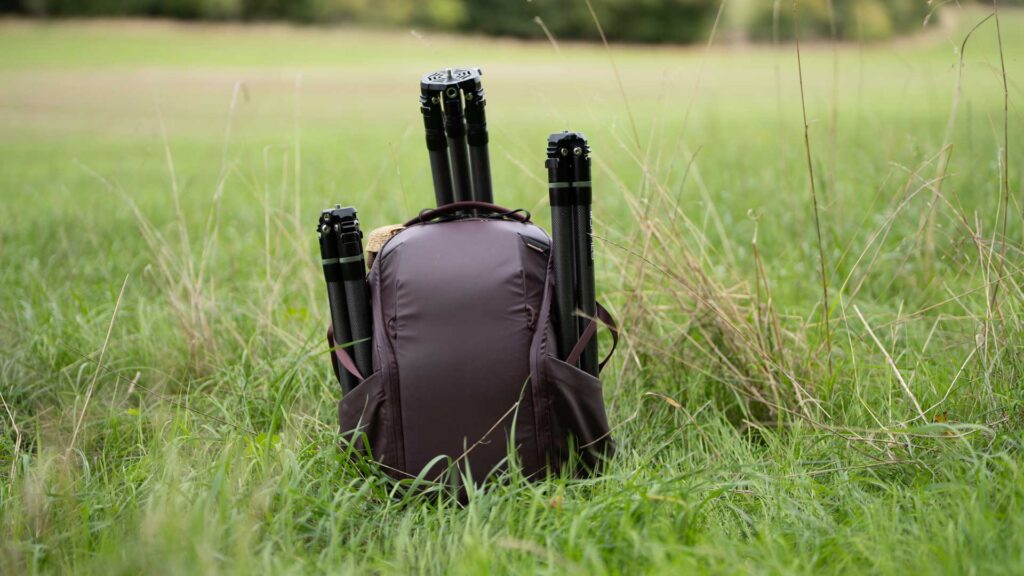
The interesting thing about testing the Modular Tactical Tripod System is that it doesn’t really have one performance profile. Changing the canopy and legs alters its height, packed size, weight and stability, which is exactly the point of the system.
At one end of the scale, the Jason canopy with the three-section legs gives the most stable configuration and it’s very good. The broader Jason canopy feels at home with a substantial tripod head while the larger diameter three-section legs create a very solid support. This is the combination I’d choose for a heavier camera and lens, long exposures in challenging conditions or situations where stability matters more than how small the tripod packs.
There’s also a hook that enables you to hang some extra weight from the tripod if you need even more stability. As always when hanging a bag or another weight from a tripod, it’s best if it can just touch the ground rather than swing freely, otherwise a breeze can introduce movement rather than reduce it.
At the other end of the range, the James with the five-section legs is the least stable combination, which isn’t surprising given that it has the narrowest canopy and the legs extend through five sections to 14mm at their thinnest point. However, ‘least stable’ is very much a relative term here because I still find it remarkably capable. I would have no qualms about using the James with the five-section legs for long exposures with a medium-sized camera setup. That’s important because there’s little point in creating a compact travel configuration if you don’t trust it when the light drops and you actually need a tripod.
There’s also a QD port on the underside of the James canopy, so that can be used to attach a strap and hang a weight for extra stability.
The five-section set weighs 807g and collapses to 34.5cm, so its emphasis is clearly on portability. That’s the configuration I’d take on a city break, flight or long photography walk when I’m expecting the tripod to spend quite a lot of time attached to my bag. It gives away some rigidity to the larger configurations, but not so much that I’d regard it as a tripod to use only with very light cameras.
The four-section set is the useful middle ground. It only adds 45g to the weight of the five-section legs but does away with the narrowest 14mm section. For general photography and landscapes, I think this is the configuration that makes the most sense when there isn’t a pressing reason either to pack as small as possible or maximise stability.
The three-section legs shift the balance much more towards height and solidity. Their 29mm upper tubes, 60cm collapsed length and 1.083kg combined weight make them a more substantial proposition, but the increase in stability is obvious. Pairing them with the Jason gives the system its strongest configuration, while using them with the James gives you much of the benefit of the larger legs in a slightly slimmer overall setup.
What I like most is that none of these choices is permanent. Traditionally, deciding whether to buy a three, four or five-section tripod is one of the fundamental decisions you make before handing over your money. If you buy a compact travel model and later realise you need something taller and more substantial, you generally buy another tripod. Here, you buy another set of legs, and if you decide you want a broader platform as well, you can change the canopy.
The removable legs add another level of flexibility. I can’t imagine needing three monopods at once, but I can imagine using one as a monopod and another as a boom or support for a light. If you’re shooting stills and video on the same location, being able to repurpose parts of the tripod could save carrying separate stands.
The alternative feet are more than decorative extras too. The Spikez Long are useful when you want to get a firm purchase on soft ground, while the Flatz address the opposite issue by increasing the area in contact with the surface and reducing the likelihood of the legs sinking. For my photography, the Flatz are probably the accessory I’m most excited about because I shoot plenty of long exposures on beaches and soft sand can be surprisingly troublesome.
Visit the 3 Legged Thing Modular Tactical Tripod System Kickstarter Campaign
The 3 Legged Thing Modular Tactical Tripod System feels like the logical development of ideas that the company has been working on for years. We’ve already seen removable monopod legs, interchangeable feet and alternative short legs, but now the canopy and complete leg sets have become part of the same interchangeable system.
It doesn’t remove the normal tripod compromises. Five-section legs still make more sense when packed size matters while three-section legs are the better choice when you want something taller and more substantial. What changes is that you don’t have to make that choice once and live with it for the life of the tripod.
That’s what appeals to me. As a female photographer, I’m very conscious of how quickly the weight of a camera, several lenses, water, clothing and a tripod adds up. Sometimes I want the smallest support I can sensibly carry, while on another shoot I’m happy to take something bigger because I’m using a long lens or won’t be walking very far. This system lets me choose accordingly.
I also like that the modular idea extends beyond the big components. The Flatz, Spikez Long, interchangeable colour accents and QD accessories all give you more ways to adapt the tripod to where and how you’re photographing.
Buying every component would be expensive and anyone who knows that one conventional tripod already meets all their needs doesn’t need to complicate things. But for photographers who shoot a variety of subjects, travel regularly or find their equipment changing over time, the Modular Tactical Tripod System is an interesting proposition.
Rather than deciding which single tripod is right for you, you can decide which configuration is right for the shoot you’re doing now, then change it when your photography changes.