
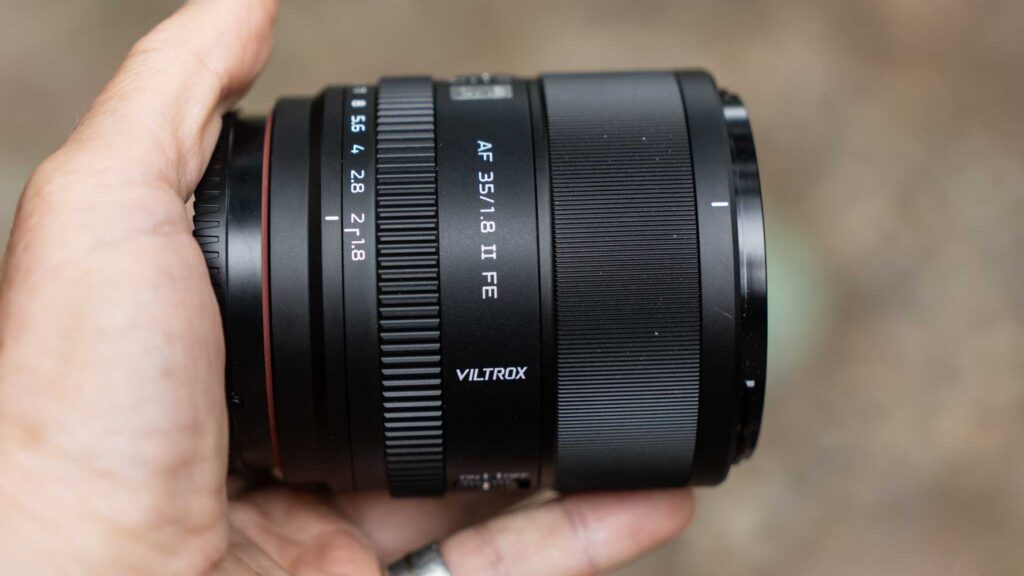
The Viltrox AF 35mm F1.8 EVO II FE is proof that an affordable lens doesn’t have to feel like a compromise. Costing just £385, it combines a compact, lightweight body with an apochromatic (APO) optical design, excellent sharpness and fast, dependable autofocusing, making it a compelling option for photographers who want a versatile everyday prime without stretching their budget.
As someone who enjoys photographing everything from travel and street scenes to environmental portraits, I find a 35mm lens one of the most useful focal lengths you can own. It’s wide enough to include some of the surroundings to help tell the story, but not so wide that people or buildings become distorted. It’s a focal length that encourages you to move your feet and become part of the scene rather than standing back and observing from a distance.
The Viltrox AF 35mm F1.8 EVO II FE embraces that philosophy perfectly. It’s small enough to leave on the camera all day, produces beautifully detailed images even at its widest aperture and feels reassuringly well-made despite its modest asking price. There are a few small compromises, but none that significantly affect day-to-day photography. For women photographers looking for a lightweight full-frame prime that’s easy to carry and capable of producing excellent results in a wide range of situations, this lens deserves a place near the top of the shortlist.
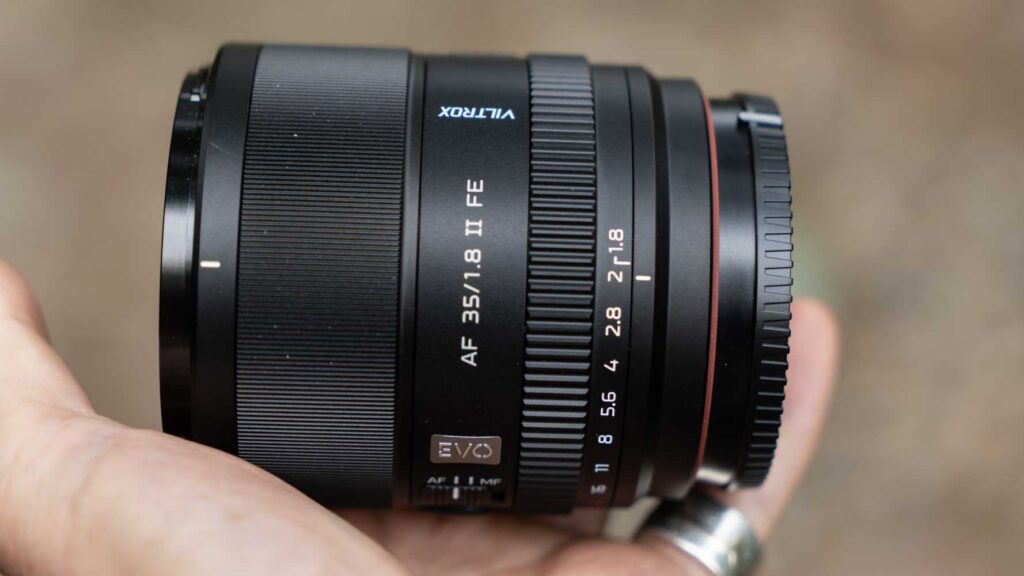
The Viltrox AF 35mm F1.8 EVO II is a full-frame autofocus prime lens that’s available in Sony E and Nikon Z mounts. It sits within Viltrox’s EVO series, a family of compact prime lenses that currently includes 35mm, 55mm and 85mm focal lengths. Rather than chasing the widest possible aperture, the EVO range is designed to provide an attractive balance between image quality, portability and affordability.
Thirty-five millimetres has long been regarded as one of photography’s classic focal lengths. It’s often the first choice for street photographers, travel photographers and documentary photographers because it captures enough of the environment to provide context while allowing the main subject to remain the centre of attention and undistorted. It’s equally at home photographing a bustling market, a family day out, a landscape with a strong foreground or an environmental portrait where the surroundings help tell the subject’s story.
Unlike a 50mm lens, which encourages tighter compositions, or an 85mm lens, which naturally isolates a subject from the background, a 35mm lens asks you to engage more closely with whatever you’re photographing by stepping forwards. That immersive perspective is one of the reasons so many photographers leave a 35mm lens permanently attached to their camera.
The Viltrox AF 35mm F1.8 EVO II FE has an ambitious specification for its price. Alongside a bright F/1.8 maximum aperture, it features an apochromatic (APO) optical design, internal focusing, a Stepping Motor (STM) autofocus system, weather-resistant construction around the mount and a programmable function button. At just 355g, it also promises to be a lens that photographers can comfortably carry throughout a full day’s shooting.
Perhaps most importantly, it costs just £385, placing it below many competing full-frame 35mm F1.8 lenses while offering specifications that, on paper at least, suggest it belongs in a considerably more expensive category.
The Viltrox AF 35mm F1.8 EVO II FE is available now for Sony E and Nikon Z mirrorless cameras with a recommended retail price of £385.
That makes it one of the more affordable autofocus full-frame 35mm F1.8 lenses currently available. Viltrox has managed to include features such as an apochromatic optical design, customisable controls and weather-resistant construction without pushing the price into premium territory.
For photographers building a full-frame system, or anyone looking for a lightweight everyday prime alongside a standard zoom, it represents particularly good value.
Looking at the specification sheet, it’s immediately obvious that Viltrox has invested far more in the optics than you might expect at this price point.
The lens is constructed from 13 elements arranged in 10 groups, incorporating two Extra-low Dispersion (ED) elements, three High Refractive (HR) elements and one Ultra-precision Aspherical (UA) element. Together, they create an apochromatic (APO) optical design.
APO is a term that’s often associated with premium lenses, but it’s worth understanding what it actually means because it has a direct impact on image quality. Different wavelengths of light naturally focus at slightly different points, which can create coloured fringes around high-contrast edges. This is known as chromatic aberration, or fringing. An apochromatic optical design aligns the red, green and blue wavelengths onto the same focal plane, dramatically reducing these colour fringes while improving overall sharpness and contrast.
In practice, that means branches against a bright sky, architectural edges and backlit subjects should all appear cleaner with fewer distracting purple or green fringes around their edges. During my testing, this proved to be one of the lens’s greatest strengths.
The bright F1.8 maximum aperture gives the Viltrox AF 35mm F1.8 EVO II FE plenty of flexibility. It allows faster shutter speeds in low light while keeping ISO settings lower than would be possible with an F2.8 or F4 lens. Equally importantly, it makes it much easier to separate a subject from the background when photographing people or close-up details.
Although a 35mm lens isn’t a natural choice for creating blurred backgrounds, the combination of the relatively wide focal length and F1.8 aperture produces an attractive balance between subject isolation and environmental context. Rather than completely obliterating the surroundings, the background often remains recognisable while becoming pleasantly soft, helping the viewer understand where the photograph was taken.
The nine rounded diaphragm blades also contribute to this effect by producing smooth transitions between areas of sharp focus and blur. Out-of-focus highlights remain rounded through much of the aperture range, helping backgrounds look natural rather than busy.
Focusing is handled by a Stepping Motor (STM), coupled with an internal focusing mechanism. Internal focusing means the lens doesn’t extend while focusing and the front element doesn’t rotate, which is useful if you’re using polarising or graduated filters.
The closest focusing distance is 34cm, providing a maximum magnification of 0.15x. While it isn’t a macro lens, this enables you to fill the frame with flowers, food, details and fairly small objects without needing to crop heavily afterwards. I find this level of close focusing particularly useful when travelling because it reduces the need to carry a dedicated macro lens for occasional close-up shots.
Viltrox has also included several practical features that improve everyday usability. A rubber seal surrounds the lens mount to help keep dust and moisture away from the camera body, while the front element has a coating that repels fingerprints, dirt and water droplets. Although Viltrox doesn’t claim comprehensive weather sealing throughout the lens, these small touches are reassuring if you’re caught in light rain or photographing outdoors in dusty conditions.
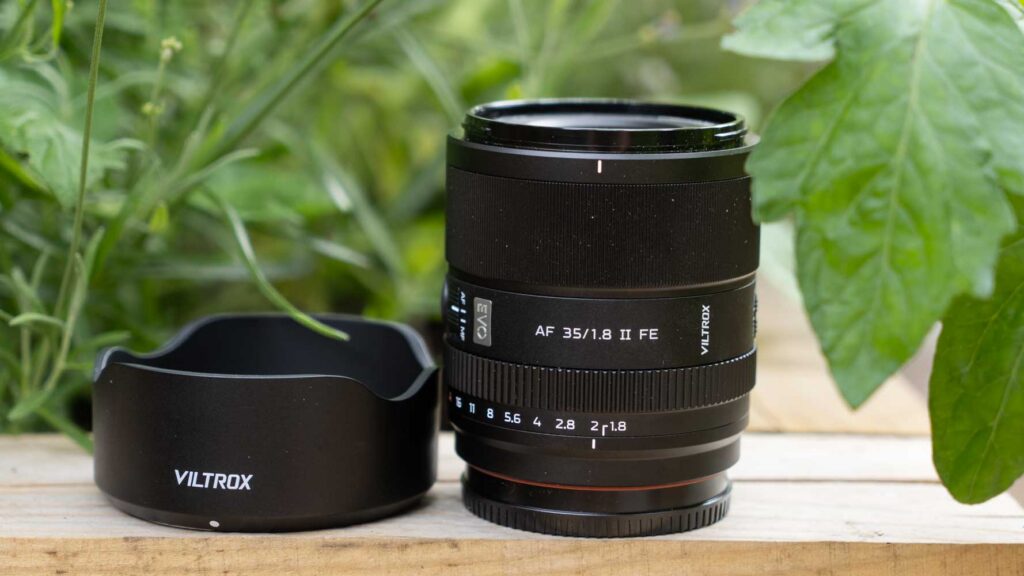
The 58mm filter thread is another welcome decision. It’s a common size, and fairly small, making filters relatively inexpensive compared with those needed for larger professional-level lenses.
Helpfully, firmware updates are carried out via the built-in USB-C port rather than requiring a separate docking station. It’s a simple feature but one that makes keeping the lens up to date much more convenient.
Unlike some budget lenses, the Viltrox AF 35mm F1.8 EVO II FE has a customisable function button, an AF/MF switch and a click/declick switch for the aperture ring, allowing photographers to tailor the controls to their preferred way of working. These are exactly the sort of features that help the lens feel more premium than its asking price suggests.
Sadly, there’s no aperture ring lock, but that’s not a deal-breaker at this price.
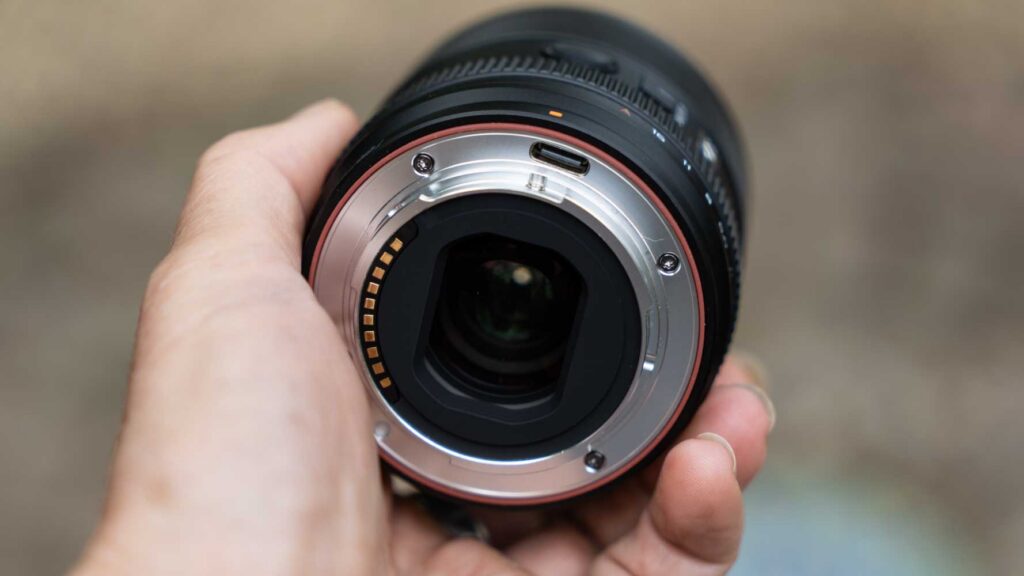
One of the things that immediately struck me about the Viltrox AF 35mm F1.8 EVO II FE is how well-proportioned it feels. There are certainly smaller 35mm lenses available, but many of them achieve their compact dimensions by sacrificing handling, optical performance or the maximum aperture value. Viltrox appears to have found a sensible middle ground.
At 355g and measuring just 76mm long, it’s light enough to leave attached to the camera throughout the day without becoming tiring. For photographers like me who often spend hours wandering around cities or exploring new locations on foot, that makes a real difference. It’s a lens that quickly disappears from your thoughts because it never feels cumbersome – I carried and used it for the duration of a four-day trip to Valencia.
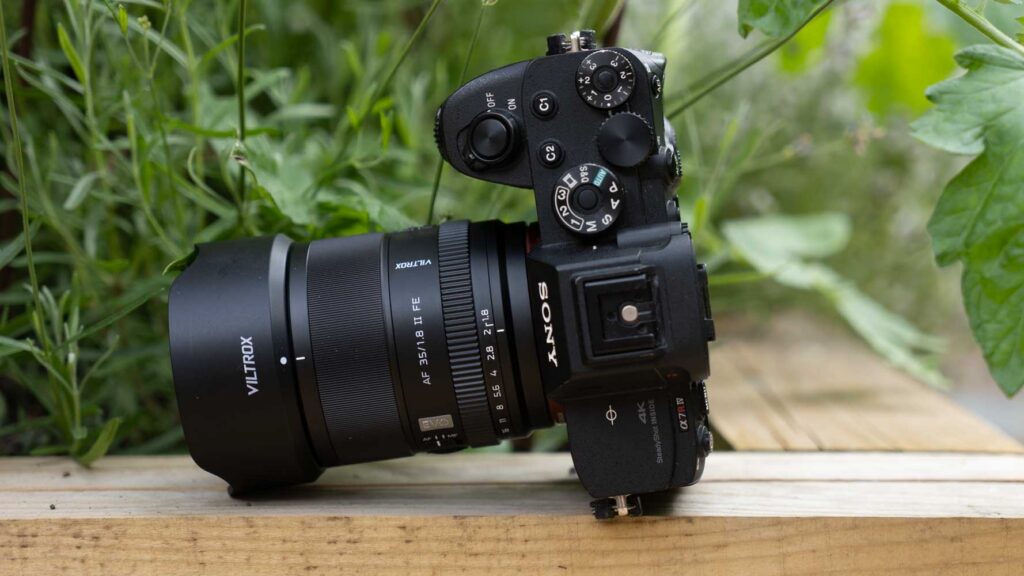
The lens balances beautifully when mounted on the Sony A7R V I and A7R V. The combination feels comfortable whether shooting one-handed for quick street photographs or supporting the camera with both hands for more considered compositions. It’s perfectly at home on smaller APS-C bodies such as the Sony A6700, where it becomes an effective 52.5mm equivalent lens that’s ideal for everyday photography and portraits.
Despite its modest price, the barrel feels reassuringly solid. The finish has a quality feel and, aside from the lack of an aperture ring lock, there are no obvious signs of cost-cutting. The focus and aperture rings both rotate smoothly with just enough resistance to make precise adjustments easy.
One pleasant surprise is the inclusion of a programmable function button. This is still relatively unusual on lenses in this price bracket and immediately makes the Viltrox feel more sophisticated than many of its direct rivals.
During my testing on the Sony A7R VI, I assigned the button to Subject Recognition in AF. This allowed me to switch Sony’s subject recognition on and off instantly without diving into the camera’s menus. Depending on the way you work, you may prefer to assign AF-ON, Focus Hold or another camera function, but whichever option you choose, having quick access to a customisable control is genuinely useful.
The button sits on the left-hand side of the barrel, making it easiest to reach while shooting in landscape orientation. I still found it accessible when shooting vertically, although it naturally requires a slight adjustment of my grip.
The AF/MF switch is positioned just below the function button and falls naturally beneath your thumb. It’s easy to operate without taking your eye away from the viewfinder, allowing you to swap quickly between autofocus and manual focus when needed. However, with Sony’s Direct Manual Focus option activated, you can adjust the focus manually when the camera is set to autofocus.
Like almost every modern mirrorless lens, the Viltrox AF 35mm F1.8 EVO II FE uses focus-by-wire manual focusing. That means there’s no mechanical connection between the focus ring and the focusing elements, so there are no hard end stops and no distance scale on the barrel. That’s now standard across most mirrorless systems and it’s something photographers quickly become accustomed to.
As soon as the focus ring is turned, compatible Sony cameras automatically magnify the image in the electronic viewfinder or on the rear screen, making precise manual focusing much easier. The focus ring itself has a smooth, nicely-damped action with just enough resistance to allow careful adjustments without feeling stiff.
The aperture ring is equally pleasant to use. It can be switched between clicked and de-clicked operation, making the lens equally appealing to photographers and videographers. The positive clicks make it easy to change aperture by feel when shooting stills, while the de-clicked setting allows smooth, silent aperture adjustments during video recording.
The only omission is a lock for the Auto position on the aperture ring to prevent lens from switching between the A setting (for camera-control) and manual control via the ring.
Overall, however, the handling is excellent. Viltrox has clearly thought about how photographers use their equipment, and the combination of sensible controls, comfortable balance and low weight makes this a lens that’s a genuine pleasure to carry and use for long periods.
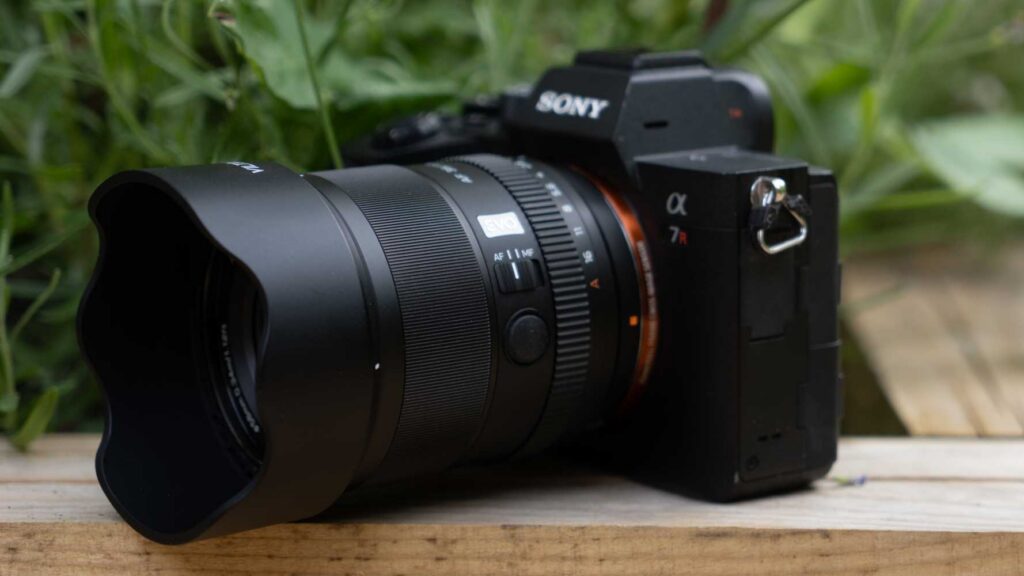
I find the Viltrox AF 35mm F1.8 EVO II FE’s autofocusing swift, accurate and almost silent. Mounted on the Sony A7R V and A7R VI, it works seamlessly with Sony’s subject detection system and consistently locks onto people and animals without hesitation. Whether I was photographing busy streets, portraits or everyday scenes, the lens responded quickly and rarely gave me any reason to think about focusing at all.
The lens also copes well with subjects moving towards or away from the camera. While it isn’t intended as a sports lens, I had no difficulty photographing people walking through busy streets or rowers powering along a river. The autofocus motor keeps pace confidently and transitions smoothly, making the lens equally enjoyable to use for stills and video.
Its manual focusing is equally straightforward, smooth and effective.
There is, however, some focus breathing, with the framing tightening slightly as the focus distance becomes shorter. Videographers carrying out dramatic focus pulls may notice it, but I don’t think it’s excessive and it isn’t something that concerned me during everyday photography.
I tested the Viltrox AF 35mm F1.8 EVO II FE on the 61-million-pixel Sony A7R IV and the 66-million-pixel Sony A7R VI, both of which place considerable demands on any lens. I’m pleased to find that it resolves an impressive amount of detail when mounted on these very high-resolution cameras.
The Viltrox AF 35mm F1.8 EVO II FE is also impressively sharp from its maximum aperture of f/1.8 down to f/16. The centre of the frame is crisp and detailed, with only the slightest reduction in sharpness towards the extreme corners. Stopping down improves the corners a little, but the difference is surprisingly small because the lens already performs to a very high standard wide open. The results at f/11 are fractionally sharper than those at f/16, but I really do mean fractionally. In practice, I’d happily choose whichever aperture best suits the subject rather than worrying about tiny differences in sharpness.
One of the biggest strengths of the lens is its apochromatic (APO) optical design. Chromatic aberration is controlled exceptionally well and, even around high-contrast edges, I saw very little colour fringing. It’s one of those characteristics that helps images look particularly clean and contributes to the overall impression of high quality.
Curvilinear distortion is also well controlled. There’s a slight hint of barrel distortion, but I don’t find it problematic and it’s unlikely to concern anyone shooting landscapes, travel or everyday subjects. Similarly, vignetting is only slight at f/1.8 and f/2 before becoming almost negligible by f/2.8, so I never felt the need to correct it.
Flare resistance is also very good. The only time I encountered any noticeable issues was when photographing directly into the bright Valencian sun. Under those particularly challenging conditions, I noticed a slight reduction in contrast together and few hot spots with some colouration in a few images, but even then I feel it adds atmosphere rather than spoiling the photograph.
The combination of the F1.8 maximum aperture and nine rounded diaphragm blades produces attractive bokeh with smooth transitions between sharp and blurred areas. Subject separation looks natural rather than exaggerated, making the lens especially well suited to environmental portraits where you want to retain a sense of place without distracting from your subject.
Out-of-focus highlights are equally pleasing. I can’t see any distracting onion-ring patterns or coloured edges, just a gradual transition to the familiar cat’s-eye shape towards the edges of the frame.
Overall, the Viltrox AF 35mm F1.8 EVO II FE produces consistently excellent images with remarkably few optical compromises. Its sharpness is impressive, chromatic aberration is exceptionally well controlled and the overall rendering has a polished, refined look that belies the asking price. Considering it costs less than £400, I think Viltrox has done an excellent job.
Follow the link to browse and download full-resolution images shot using the Viltrox AF 35mm F1.8 EVO II FE
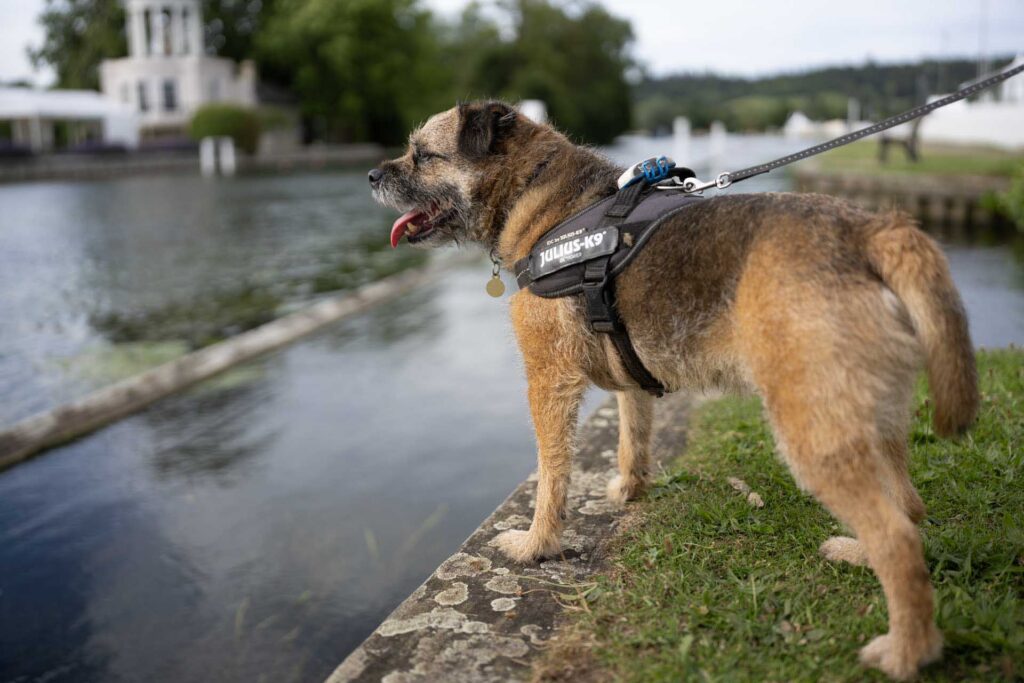
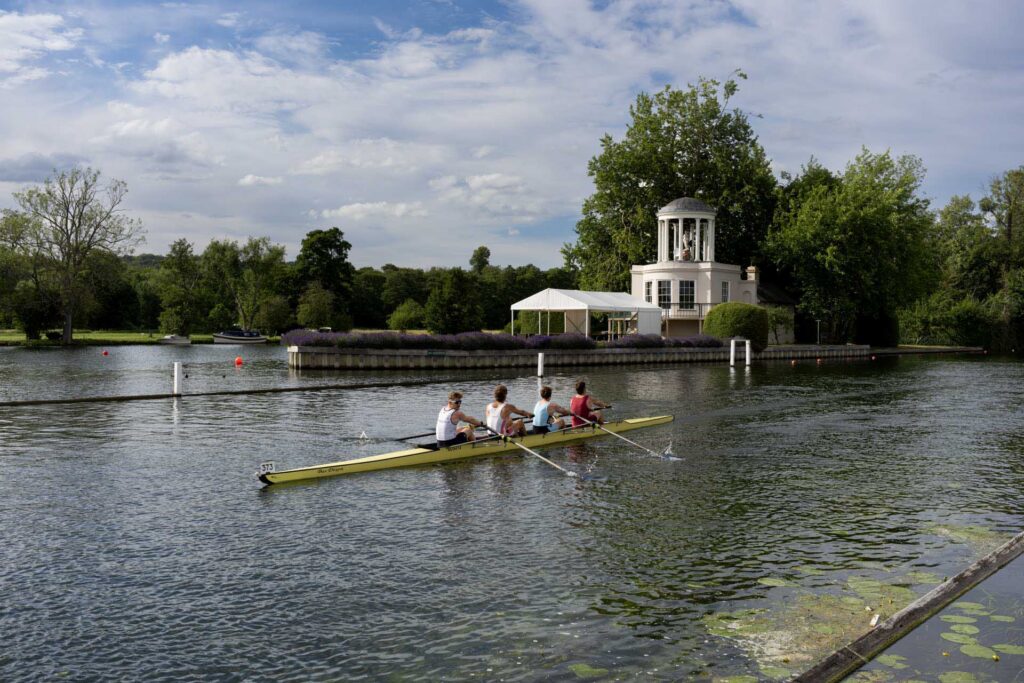






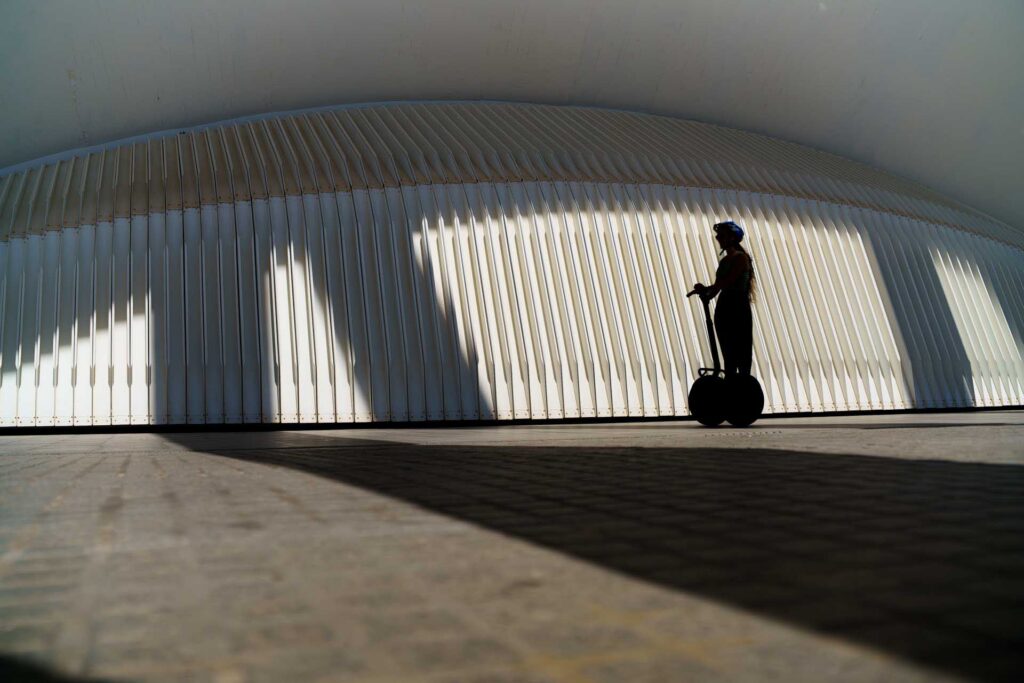


I like the Viltrox AF 35mm F1.8 EVO II FE a lot. It feels well-made, handles comfortably and delivers the sort of image quality I’d normally associate with a considerably more expensive lens.
The compact dimensions and 355g weight make it a lens that’s easy to carry all day, whether you’re exploring a new city, photographing your family or simply heading out with your camera for a few hours. I also appreciate the inclusion of practical features such as the customisable function button, AF/MF switch, click/declick aperture ring and USB-C port for firmware updates, all of which help it feel more refined than its modest price suggests.
Most importantly, the Viltrox AF 35mm F1.8 EVO II FE produces consistently excellent images. It’s impressively sharp across the frame, even at f/1.8, while chromatic aberration is exceptionally well controlled thanks to its apochromatic (APO) optical design. Distortion and vignetting are both minimal, the autofocusing is fast and reliable and the smooth, natural bokeh makes it equally at home shooting environmental portraits as it is travel and street photography.
There are a few minor compromises. Focus breathing is noticeable during dramatic focus pulls and flare can become visible if you’re shooting directly into a bright light source, while an aperture ring lock would have been a welcome addition. However, none of these issues proved significant during my testing.
At £385, the Viltrox AF 35mm F1.8 EVO II FE offers excellent value for money. If you’re looking for an affordable, lightweight 35mm prime for Sony E or Nikon Z, it’s an easy lens to recommend and one that performs well beyond what its price suggests.